
Opo Ngawaka, Kaumātua (Māhuki Island, Aotea)
Interview with BARRY SCOTT
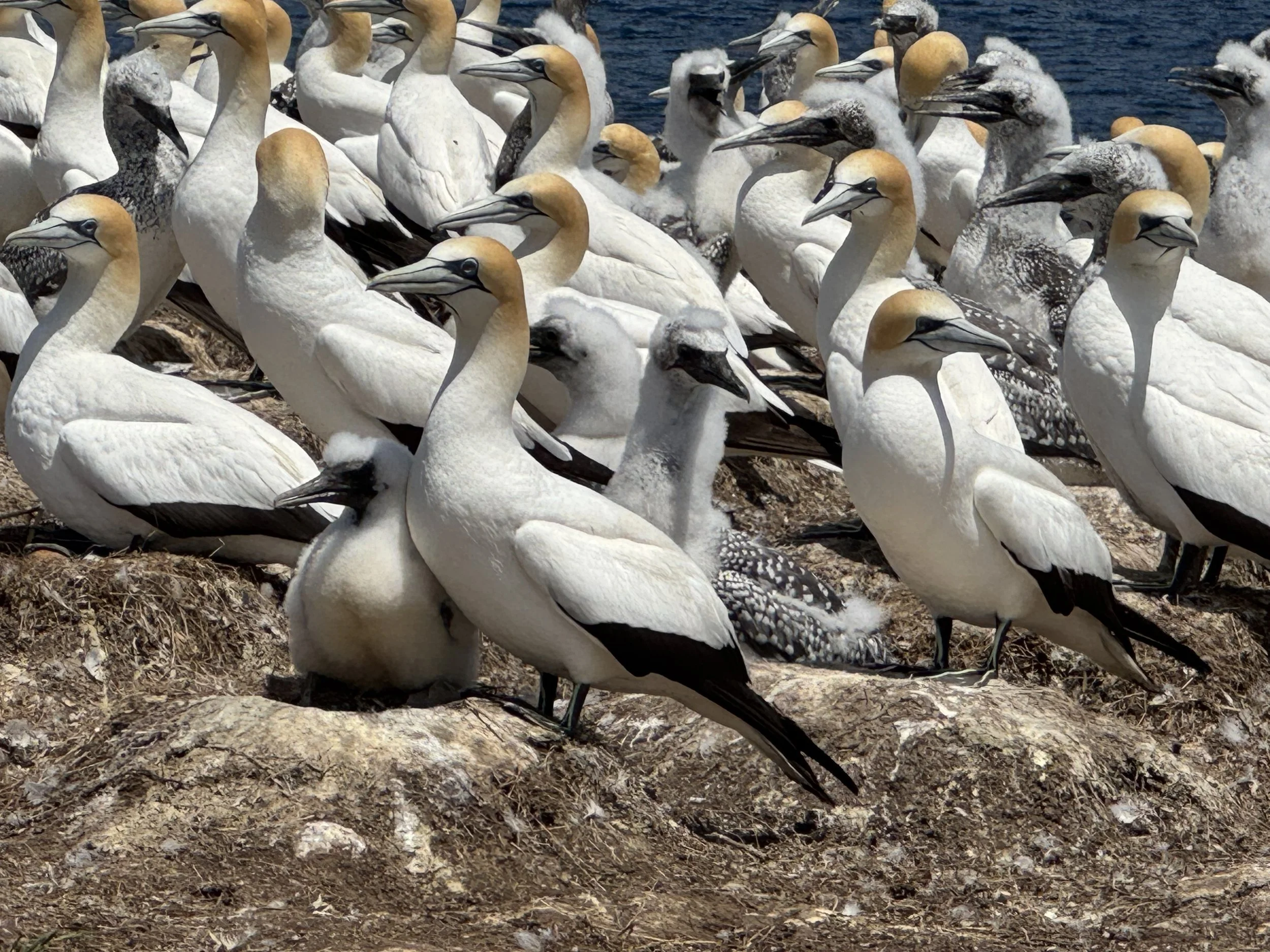
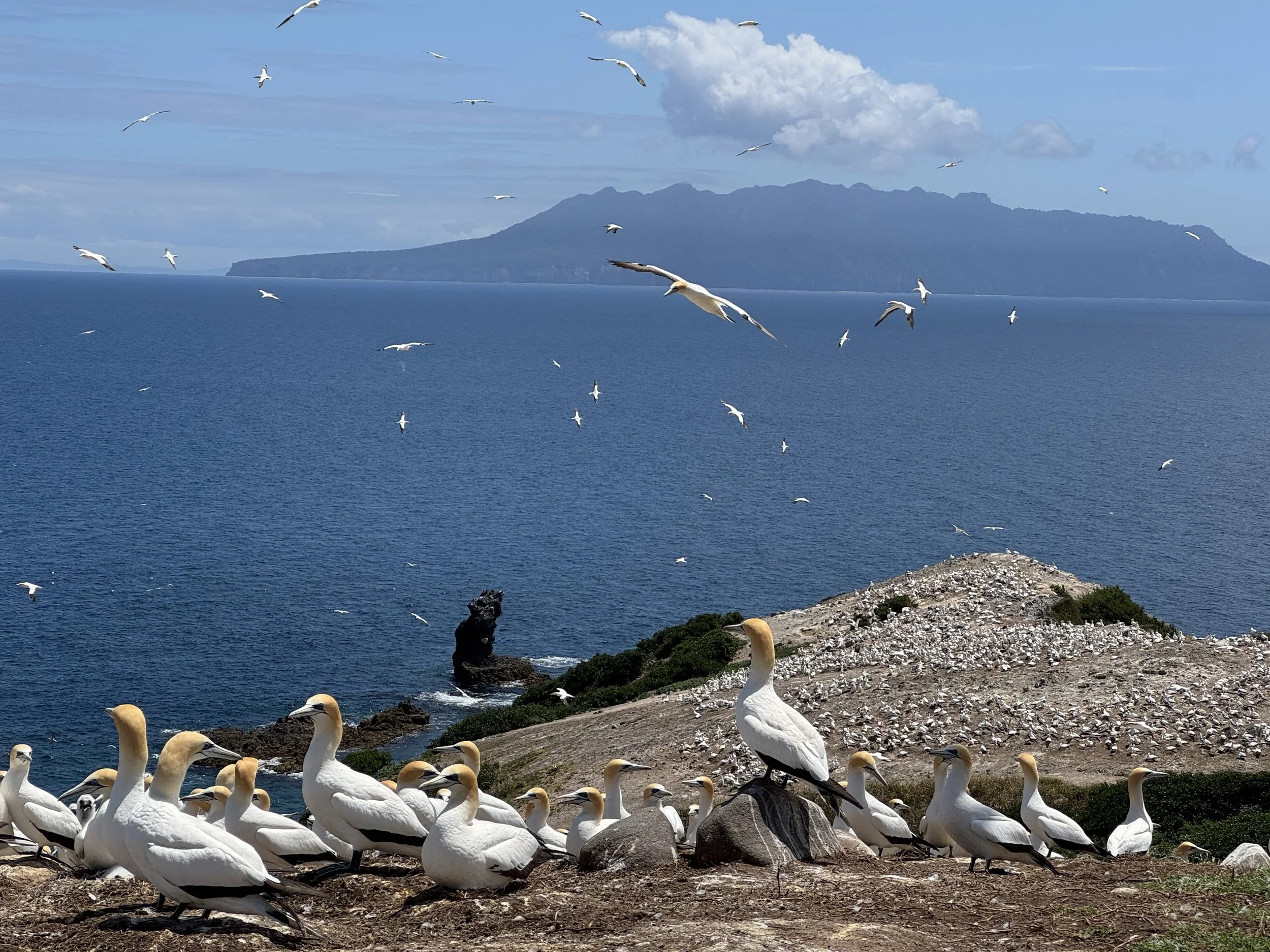
Kaumātua Opo Ngawaka lives on Māhuki Island with his wife Elaine, son Jeremiah, and dog Missy. They share the island with one of our largest takāpu/gannet colonies in Aotearoa. He is a former chair of Ngāti Rehua Ngātiwai ki Aotea Trust and a current member of Tū Mai Taonga Steering committee, a NRNWKAT-led conservation project on Aotea. Growing up on Rangiahua he has seen many changes on the whenua and moana during his lifetime.
To start off could you tell me a little bit about living on Māhuki Island and what changes you have seen on and around the Broken Islands in your lifetime.
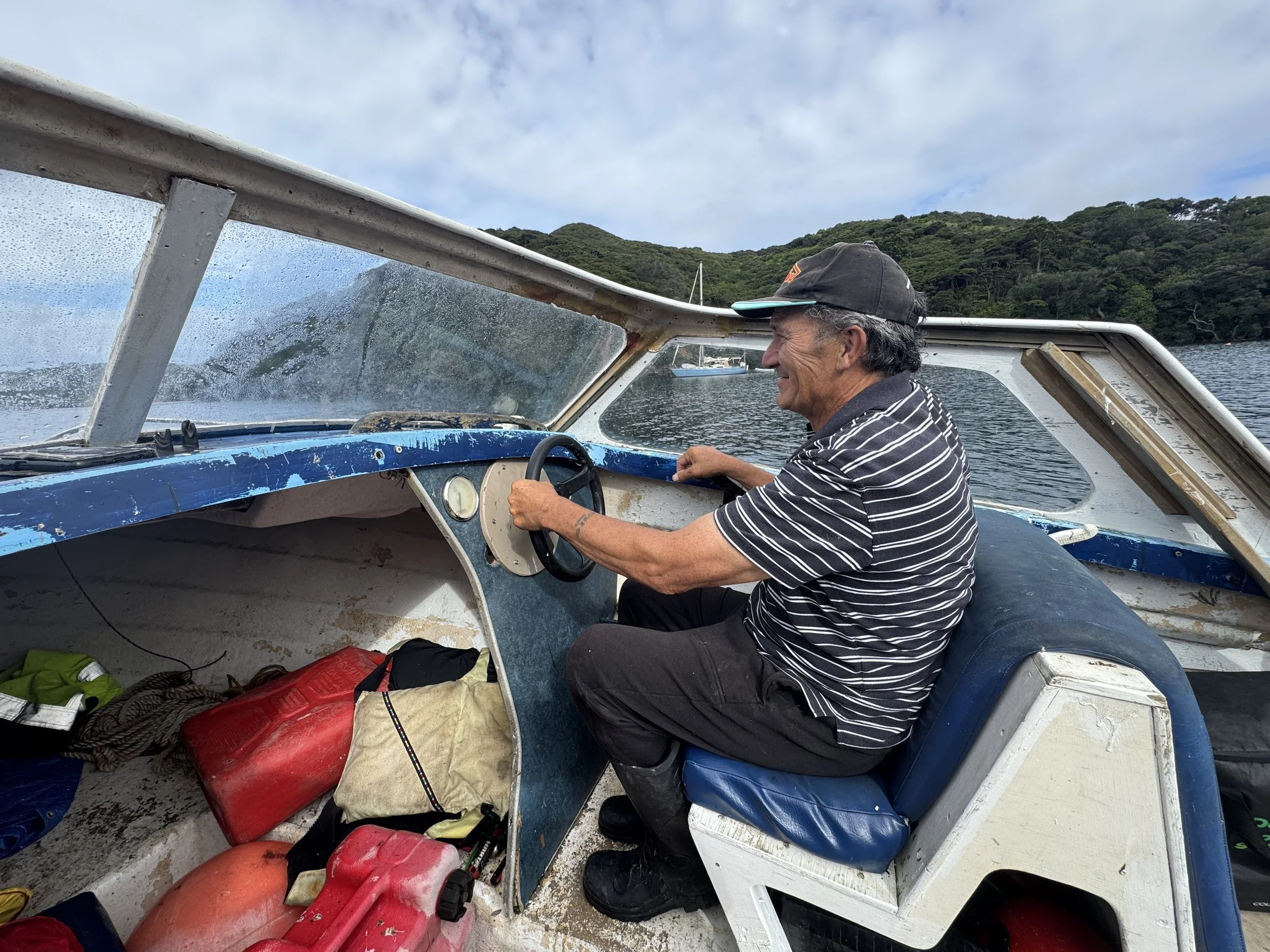
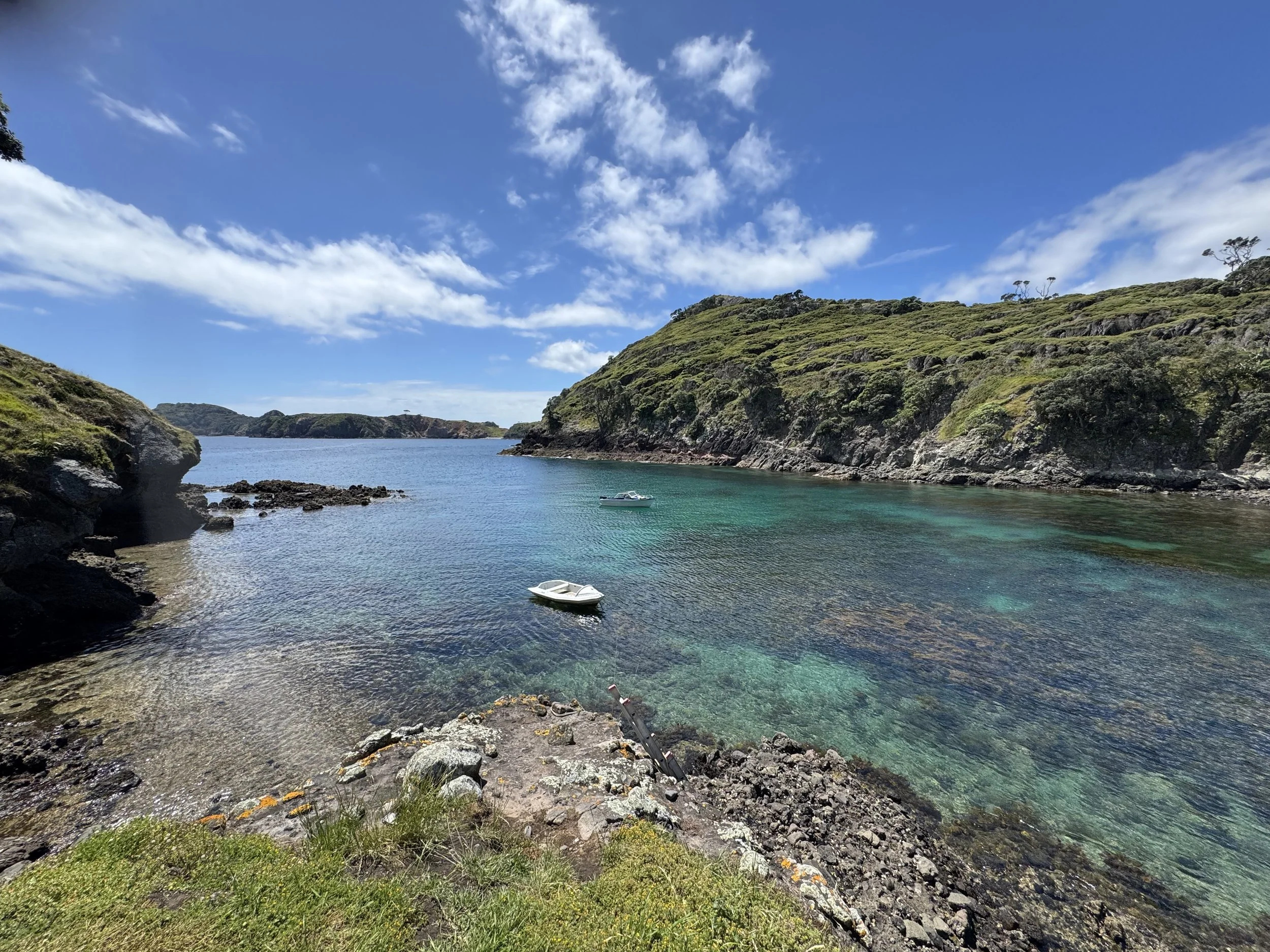
After Elaine and I got married, we moved here around 1982 and built our first house on the ridge in the middle of the island. At that time the island was all grass. But after living there for a while we thought we were going to get blown away as it was so wind swept. So we took it apart bit by bit and rebuilt on the current site, which used to be the cattle yard. We lived in a tent for three months as Elaine, myself and two of our three children at the time rebuilt the house. Now there are a lot of trees so we are much more sheltered from the wind and the house doesn’t shake like it used to.
I presume you would get a lot of your kai from the ocean on your backdoor step and you would have a vegetable garden?
Yes we grew a lot of kumara and potato and other things, to keep us going through the winter. It was always in winter preparing for the spring and spring was preparing us for the winter. Growing vegetables stems from our parents, they were gardeners. It has to be, you know, to survive. But there were rats everywhere. I came into my house one day and lifted some sheets of ply leaning against the wall to find six rats hiding in there. They had just snuck in and made themselves at home. They'd swim out to the boat and crawl up the mooring rope and get into your boat and make a heck of a mess. They could smell something out there and anything plastic they'd eat through it, even the hydraulic steering hose line. We even found whole gannet eggs in the mānuka and grass near the house, which had presumably been rolled over and down the hill by the rats! It's like a highway for the rats from Sven’s property on Aotea, to Rangiahua and onto here. Their main aim was to come out here because they could smell the gannets.
You were saying when we came in on the boat that when you were young there was just a small takāpu colony on the western peninsula.
Yes it was quite a small colony at that time but they must have already been here for a long time as the guano was 300 to 400 mm thick at that time. I heard there was once a colony on an island off the coast of Waiheke but it is not there anymore so the original birds may have come out from there. With time the colony has just got bigger and bigger, and so fast. Despite the rats being here, they've managed to successfully breed and, in fact, grow. The rats used to take a few eggs but otherwise didn’t seem to have much impact on them.
And what about other seabirds on the island?
Yes, we get the manu ōi/grey-faced petrel. They are mainly on the cliff face on the southern side. They nest there every year but I don’t know how many burrows are there as its too steep to climb down to and the soil is quite hard. They seem to nest under the roots of the pōhutakawa. Little Māhuki, where my sister has a house, was once covered in manu ōi burrows. It was all grass, and they just threw the grass everywhere.
Are there still lots of manu ōi on Little Māhuki?
Not so many as someone’s dog swam across there about 10 years ago and caused real havoc. It was devastating. Dogs can be really lethal when they get a taste of it. But the population is recovering. It's going to take some time before they get back to the level they were at. There is no one living on Little Māhuki at present so that helps protect them. It's quite a steep island getting up from the beach, with stairs going up and up.
So what are the big changes you've seen on Māhuki since you've been here from the 1980s?
When we came here to live the island was mostly grass with around 35 cattle and some sheep grazing here. But around that time Auckland Council wanted the islands to be called Paradise Islands, so to make that happen, they had to eradicate all the rodents from these islands by carrying out a toxin drop. My father gave them permission to do that but on condition that they first remove the cattle. But when the contractor came to remove them he was going to just shoot them and dispose of them on the Māhuki and Rangiahua, which our people were not happy about. So they reverted to the original agreement of shooting them and ferrying them to Rangiahua for distribution of the meat to whanau. Auckland Council then proceeded with the toxin drop on Māhuki, Rangiahua and Motutaiko Islands in 2007 That was successful and we were free of rats for several years.
Did you see much of a change after the rats were gone?
Yes, we could leave our doors open at night and every night. Auckland Council continued monitoring for rats around the island every quarter. They had about 15 trap stations on Māhuki and a few more on Rangiahua. Every autumn they found rats were swimming across from the main island, but when they trapped them they found they were all males. They were all looking for a mate. They would swim across and hike around the island looking for a mate and if they couldn't find a female, they would swim back. They are very good swimmers. It was in their DNA, I think. And their sense of smell must be very good.
So when did the rats get back onto Māhuki and the other Broken Islands?
In June 2014 there was a massive storm on Barrier that caused a lot of damage including destruction of the old kauri dams on the Kaiaraara stream. Many logs were washed down the flooded streams and drifted out to the Brokens ferrying rats. They hopped on the logs to escape from the flooding. You might remember a dog being found on one of the logs drifting out in Fitzroy harbour? Someone found him and rescued him. It was my nephew Ben’s dog. They didn't take long to multiply again. Within a couple of years, there was rats everywhere again. They breed up pretty fast.
Were they mostly ship rats or also kiore.
No, all ship rats. I don't remember seeing kiore on these islands. I don’t think kiore like swimming.
Were there mice on Mahuki?
No we have never had mice on this island but there were some on the other islands. They were eradicated when the toxin drop was done.
So there has been no further control of rats on Māhuki until Tū Mai Taonga arrived?
Yes that’s right. But one of the big challenges was Predator Free 2050 didn’t want ‘knock-down’ they wanted eradication, which was possible for feral cats but they were not on their list of predators to remove. So even though we started our work in the north, in the Te Paparahi block, right from the start we were thinking about how we might get continued funding. So we started planning for elimination of rats on the islands very early. Our success there helped us get a second round of funding. Using bait stations across the island Tū Mai Taonga have now successfully removed rats from Māhuki, Rangiahua and Motutaiko, and are now working on eradicating them from the more difficult to access smaller islands. You need some pretty agile, skilled people on some of those islands. They're pretty rugged and you have to pick your days for landing on those islands.
I hear there are now around 30 people working for Tū Mai Taonga.
Yes, Tū Mai Taonga had to expand their numbers because Great Barrier is split up into five blocks, to progressively target feral cats while they work on a plan to eliminate the ship rat. They're now working on block two but have to continue monitoring block one and are almost ready to start trapping feral cats in block three.
I was listening to Chris Giblin yesterday, who said that from the trail cameras they estimate that there are fewer than 20 feral cats left in the first block.
Yes, that's a big success. I think we are going to see some big improvements in Te Paparahi from when we first started. I talked to one of the workers when they first started to clear tracks in preparation for laying the cat traps and asked them how many birds they had seen on their two-and-a-half-hour walk to Tataweke hut. Their reply was just one bird every kilometre, which gives you some idea of the state of the forest when it comes to bird life. Hopefully with time we will hear more birds but we've still got the rats to attend to.
Chris also said they were successful in getting two rounds of Predator Free 2050 funding.
That’s correct. When the project began I was Chair of Ngāti Rehua Ngātiwai ki Aotea (NRNWKA) Trust and there were a few hurdles to negotiate to get it going. The recipient of the funding needed to be a Charitable Trust so NRNWKA Trust was already structurally in place and set up to receive the funds.
I recall AGBET was involved with the Predator Free funding and the whole project getting underway.
That’s correct. I was initially reluctant to receive the funds because when you talk about eradication of rats, it's a huge undertaking. I also thought it was a good idea to talk to all the conservation groups on the island and send a letter out to them, to ask if they supported us in leading this project. We had 27 letters back from different conservation groups and schools and organisations. There was good support from everyone. There was very good buy-in from the residents of the north who participated in a survey organised by Fiona Cameron.
So once the rats were removed that first time from Māhuki, did you notice more birdsong out here?
Yes and no, because it's very seasonal for them here with the grass seed and everything. There is also not much mature forest. When the stock were removed in 2007, a year later we had a drought for about 8-9 months. The spring that provided water for the cattle dried up and never ever came back. So luckily we took the stock off before that drought as the they would have died.
You said that initially the island was mainly grass and gorse, but we look out the window now and it's lots of mānuka so it's obviously regenerated considerably over the last 40-50 years.
Initially there were just a few trees. We planted some native trees but most of the trees have grown from seed the birds have brought in. We have now got mānuka, kānuka, harakeke, kāro, five fingers, puriri and a range of other native plants coming up. There has been a big influx of bird life especially since the recent eradication of rats by Tū Mai Taonga. One of the big changes has been the abundance of karamu berries. When the rats were here, they just cleaned up the ripe orange berries in no time. Just recently, when I went up the back paddock to feed the hens there were 12 kererū sitting in one tree resting in the sunlight. When I walked back home and I looked at the karamu, which the day before was loaded with berries, I noticed all the berries were gone.
Do the kaka come out here?
They do a navigational route and then they go back. They don't stop. They just fly over. We had one fly low around the house to see what was here then it went back to Aotea. Thank goodness because they would clean up all the fruit on my trees. They are amazing birds but they're a bit destructive.
So Tū Mai Taonga has been a really big thing for mana whenua providing employment for some on the island and some who have come back to Aotea to live.
Yes it has been a very big thing for us and Aotea. But I have to say that it is not for everyone. It's pretty hard going at times. Some people don't realise that until they actually do it themselves. Some of the team come out here to monitor the traps and come back with scratches all over their legs from the gorse but it does not seem to bother them. Also, it can be pretty monotonous when every trap is empty.
But I guess they are picking up other skills from the technology being used to map and record traps and catches with the hub at Akapoua?
They have got skilled people working there, with the technology available to them, the whole process of monitoring and checking is more efficient, because it feeds back with the data from the trap into the system. You know whether the trap has gone off or not.
Are you still involved with Tū Mai Taonga?
Just on the steering committee. It has been a good group to work with. I enjoy being there because rodents are not my favourite species, so that's why I like being there to keep an eye on how it's all going, and hopefully able to have some input into progressing the work forward as it affects us all.
I presume in the long term you would like to see Aotea rodent-free?
Definitely. I never say it's impossible. It's just a matter of plugging away at it and we'll get there.
I think the biggest challenge is privately-owned land, and who walks across it. Most prefer that their own family do the trapping and control work on their properties, which I think is great that everyone has an opportunity to look after the space they live within.
At the Ecology Festival earlier this year you talked about the thrill of seeing the humpback whales passing through the Hauraki Gulf when you were young? That must have been quite a sight?
It’s one of those sights you never ever forget, and the excitement of it all. There were lots of whales. You would see them breaching and spouting away in the ocean between here and Hauturu. They would come from the north to feed in the Tikapa moana, then head south back out the Colville Channel, and then down the coast on their long voyage to Antarctica. Then the whaling started up out of Whangaparapara and they were decimated. That was a very sad thing to happen. Sometimes you don't realise the damage being done until it's gone, it's done.
I also remember you saying that many years later you saw the humpbacks way off the east coast of Aotea when you were fishing. So they changed their whole migratory path?
Yes. I was tuna fishing at the time, one of the very first out of Auckland. While it was a way of making a living it was being out in that ocean and what I saw that was really interesting. I had been wondering where all our manu ōi had gone after the whales had been decimated through the Gulf. We accidentally ran across the whales new migration path. It was so amazing to see all those big families of whales coming through in groups all day long. We were usually out there for five or six days, well out of sight-of-land, and sometimes we would end up way up north.
Were there other species of whales besides humpbacks that used to pass by the Brokens?
Sperm whales used to come through here as well. They were also migrating south but I haven't seen one since.
What about the Bryde’s whale that live in the Hauraki Gulf? Do you see them out here?
I've seen one come into one of our bays here, probably hunting for food. It was right in close and easy to see. We also see them spouting sometimes.
And when the whales are feeding that brings in the seabirds?
When the whales came through, a lot of those seabirds used to feed from the fish debris. My father used to talk about that a lot when I was young. They would feed off the remains and overspill from the whales' food and activity. The birds used to hang around and feed off that a lot - the black petrels and most of those seabirds. Since the whales have gone, I always wondered what happened to a lot of those birds. I used to look for them when I was out tuna fishing - up to 80 nautical miles off the Barrier.
I also wondered about the manu ōi, because it was such an important food source for us in the early days. Our tūpuna would go out to the Mokohinau islands and stay there for two to three weeks to harvest them. To preserve them they would put them in their own oil in 4 gallon tins. They would slow cook them in camp ovens until all the moisture was gone, with just the oil left. The oil enabled them to be stored for a long period of time. They would harvest them just about when they were getting their flight feathers, which was around November. That’s when they were in their best condition.
Over the years we noticed that more and more birds were in a bad state and we wondered why they were not breeding as well. They were breeding, but not surviving, One possibility was the culling of the whales removing an important food source for them. My father used to talk about how, they used to feed off the whales themselves - the oil. He used to talk about when a bird was in good condition the gallbag would be full of an olive- or honey-like oil. If you harvest a bird now, you will often just find a lot of rotten fish in the gall bag. But we don’t harvest them anymore – a decision was made by the kaumātua not to harvest because of the lower bird numbers and the generally poorer condition they are in. The monitoring we carried out showed that of every 10 birds you would pull out of a burrow just one would be in good condition. They need to be in good condition to survive. That was a real indication to us that there is something wrong with the marine ecosystem somewhere. Our way of monitoring is slightly different from the scientific way of monitoring. It's part of our matauranga. It's a practical and simple way of monitoring. But the problem is the cause. There is certainly an imbalance somewhere. Overfishing is part of it but whaling may be another part of it. The other thing I noticed while tuna fishing was how far out the ōi were. They used to be found in the Gulf, but not anymore. As the pressure came on they and other seabirds moved further out. They are a shy bird and usually on the outer edge of the sea bird distribution across the sea, with the more aggressive birds closer to the Gulf. Generally we would not see one until 40 kilometres off the coast, so they're right on the outside.
Were there any issues for you with the sea birds when you were fishing?
One problem we had were the birds chasing the bait. So we would set them in the dark – about 4 o’clock in the morning. Most commercial fisherman now do that but there are still some bad practices out there.
How is the fishing around Mahuki?
It’s pretty good. We are able to catch snapper all year round. But recently I have caught some that are not in good condition – very white milky flesh. I see it mainly in shallow areas where there is a lot of sand.
What about the kelp forests, are they still quite good?
When we had the cyclonic weather for a few years I saw a deterioration in the marine life, mainly on the western coast of Aotea. There was a lot of silt from the excess of rain. We found big patches of barren coastline with no seaweed, no kina, just nothing. But in the last year or two we started getting our westerlies back, which are our trade winds. The silt has cleared and the seaweeds have grown back. It’s all happened quite quickly. In six months, I've noticed about five types of seaweeds that have grown by a metre or more in the bay below our house. Also, lots of maratea/red moki among that seaweed. You see fish travelling in and out of the seaweed everywhere.
There have been some big changes from the recent CRA2 review with many on the Barrier concerned about the pressure that will now come on the island with the inner Gulf closed to rock lobster fishing.
I've never liked the zoning of the commercial fishing areas that are in place by the powers that be because we have lost control on a small area of the ocean that we live in. For example the zoned commercial area for CRA2 is from East Cape to just north of Aotea. It's too broad and anyone who has a CRA2 permit and quota can come here and fish.
When our people used to fish here, if there was a bad season, they would stop and let the population build up again. I remember my father saying, when he moved to Rangiahua, that there were crayfish out in the sand. He used to catch them in bricks soaked in kerosene. He said one year there were many crayfish around, and then the next year there was nothing. They just disappeared. It wasn't over fishing.
So even in your father’s time there would be bad seasons?
Yes there are cycles, where they decline and then a couple of years later they'll be all back again. But that is not to say that's the case now. I think there is over fishing. I think there's a lack of training and knowledge about the kourā as when a diver dives down, they see koura tucked away in cracks and crevices, and sometimes they take them all. From my experience, because we've been crayfishing for four generations now in our family, is if you clean them out they may not return. For example, about 40 years ago some of our whanau cleaned this hole right out, and to this day there have never been any kourā return to that spot. Jacques Cousteau did a study on their migration. We have experienced a similar result, during those off-seasons a number of crayfish stay behind. When the others come back, they know where to go from those that stay behind. So there is some sort of communication between them. So if a diver cleans out a hole in those off seasons that communication breaks.
So it is hugely challenging when this is all in the hands of Fisheries New Zealand and you've got both commercial and recreational boats fishing all year round.
One of the big problems is the small boats that sneak out here and drop divers into the ocean. You have no idea whether they're cleaning it out or just taking one or two. We saw one of those small boats pull into Māhuki this morning when we arrived. When we are out on the water we quite often see a boat diving, and it shoots away, and no one knows about it, except those who've seen it for a very short time. We see the big boats, and we think they're the ones overfishing, but often not.
So how do you think we should manage this?
The problem for us is we have not been given the opportunity to manage our own areas. At the end of the day, we're going to save government a lot of money. We are residents here.
So how do you formalise that? Would you like to see regulation by Rāhui, Mataitai or Taipuri, which are known mechanisms deployed elsewhere?
I think one of those methods we should be all happy with. We just need to work together on what is the best method that suits us here.
Politically the lead for this would have to come from the NRNWKA Trust working with Fisheries New Zealand?
I think it's a partnership way of doing things. There was a survey done of all the iwi within the Hauraki Gulf area and they were all opposed to bottom trawling, Danish seine, and any method that drags on the seabed including scallop dredging. We are all saying the same thing. Get rid of it, or it's not the right method. For some unknown reason it's still going on. I remember having two or three Zoom meetings with Fisheries NZ, and of course they had set questions they needed to ask, which was fine, but they were not listening. For us to survive, we have to look after our own areas. That's how it used to be, and it should be no different today. For us to go and catch a snapper or a kourā, we want them to be there. Why wouldn't you want to look after it?
Switching to the highly invasive exotic caulerpa. This is a terrible invasive seaweed that was first detected at Aotea. Its recession recently indicates it may not be quite as bad as we originally thought, but certainly in those early years when we saw meadows of it across Okupe Bay and right up this western coast we were worried. You must have seen it come right through the Brokens and round into Fitzroy. What sort of impact did that have on your people?
It didn't affect us too much apart from the restrictions that were put on us. But it was a really frightening thing to begin with, and so little known about it and how it might behave. But not so much concern now. It's pretty remarkable how much of it has gone from around here, and it seems to be a bit of a mystery to everyone, even the scientists. What is unbelievable is how deep it is found through the Broken islands. My brother has been crayfishing through here for many years. Up until a couple of years ago he was picking it up on his anchor everywhere. But not anymore.
I have followed the Ahu Moana group quarterly surveys around Schooner Bay and learnt so much from them. Glenn was commenting just last week at a workshop that from their surveys they had not found any evidence for large negative impacts by exotic caulerpa on the native flora and fauna, which I found very interesting.
I used to like getting those newsletters from Glenn, and they all did those surveys on a volunteer basis. When you evaluate the period of time since 2021, I'm much more relaxed about it now than I was in 2021. It did seem like it was never going to go away, but we're finding, well, nature is a great partner, and hopefully it was looking after us a little bit.
What other things have happened recently that you feel excited by or positive about in terms of the future of Aotea and life out here?
I'm not sure excited is the right word but I am positive about a number of things. One thing I'm really happy with is people are getting on board with caring. Yes, caring about the environment they live in. This island that we live on. I think it's great when education is part of that, because it makes us comfortable when we know what's going on and what's happening.
And you presumably, like me, want to see the place in good health for the grandchildren?
Definitely, as they are the future.
The other thing I spoke about at the eco-feast was where does our satisfaction lie when it comes to looking after our moana, our whenua, our airspace and our fresh water and so forth. My children are going to grow up accepting the way it is and hopefully it'll stay like that. And when they become old or older, they'll probably be saying the same thing as I was, well, this is how it used to be. But actually, it wasn't like this. This is not how it used to be.
It's that sliding baseline that Glenn talks about often?
Yes, I refuse to accept the kōrero or the talk around this that it is acceptable the way it is. It's not acceptable. We need to do better,
So that's your message?
Yes. We should never accept the way it is. We should always strive to do better. The Hauraki Gulf has just been hammered and destroyed. The life force in that sediment on the bottom is just destroyed. That's why we are not getting scallops growing the way they should be. It's going to take time to heal. I don't know whether you read about the experiment they did down in Nelson. The scallops disappeared down there. They decimated the whole area with dredging, and so they decided to replant it all but the scallops died. They replanted it again, but again they died. Then they did some research and found that the sediment on the bottom creates a life force that the young ones feed off. And when you dredge it up like a garden, it kills it all. It is the same problem in the Hauraki Gulf but no one's listening. You just don't disturb the sustainable life force in our moana for all creatures.
Thank you Opo. I think a good heading for your interview is ‘No one is listening’.