
Island Conservation: Presentation to the Aotea Ecology Festival 2025
RICHARD GRIFFITHS (Head of Operations, Pacific Region, Island Conservation)
Part I: Putting the removal of rats, feral cats and pigs from Aotea into the global context
Islands like Aotea are important for many reasons. Globally islands comprise just a small proportion of the earth’s land mass, around 5%, but they support a disproportionate share (nearly 20%) of its biodiversity. The same holds true for languages and culture, with islands once again being overrepresented globally. Aotea exemplifies these characteristics with its own distinct biodiversity and cultural heritage.
Unfortunately, what makes islands special also makes them vulnerable. Seventy-five percent of all extinctions that have occurred in the last 400 years have been island species. And today, over 40% of the world’s threatened vertebrates are found on islands. As we know from living in New Zealand, our biodiversity is in trouble and the most immediate threat is no longer habitat loss, it is not yet climate change, it is invasive species.
Aotea has fewer invasive species than many parts of New Zealand, but it does have a number of the species featuring in the top 100 list of the world’s worst. The removal of several of these species from Aotea is the subject of this article. Before launching into what is possible though, it is worth touching on the important mahi that has been done in the past on the island and the work that is currently underway.
The removal of goats from Aotea in the 1990s was a major milestone and undoubtedly changed the downward trajectory that parts of the island were on. Initiatives such as pig, feral cat and rat control at Windy Hill and eradications undertaken at Glenfern Sanctuary, on Motu Kaikoura, the Broken Islands and Rakitū have yielded inspiring results and glimpses of what could be achieved on Aotea if these species were removed from the island. Work on removing all feral cats from Aotea is now underway led by Tū Mai Taonga who are making great strides in the north of the island.
Globally there is great precedent for removing cats from islands. They have been removed from close to 100 islands around the world including islands much larger than Aotea. Dirk Hartog Island in western Australia, completed now nearly 10 years ago, is more than twice the size and large operations are in the works with plans to remove cats from Maukahuka in the Auckland Islands, Rakiura and the Chatham Islands. It is fair to say that fewer cat eradications have been undertaken on inhabited islands but there are examples. A few notable ones include Lord Howe Island, Tristan de Cunha and Ascension Island.
So, there are many examples from which to derive inspiration that Aotea may one day be cat-free. Tū Mai Taonga have an amazing team in place and much better tools and technology than was used back in the day on islands such as Hauturu so my hope is that the community gets in behind the mahi that Makere and the team are doing and that sufficient resources are found to deliver this outcome.
Rodents will be a trickier target for Aotea. Removing rats from inhabited islands is not a simple task, current methods require rodent bait to be placed into every rat or mouse territory across an island to be successful, so the buy-in from the community needs to be exceptionally high. Getting everyone to agree to this in an island community seems impossible but there is a growing list of examples where it has been done
Rats have been removed from more than 1000 islands worldwide, 100 of these have been New Zealand islands. And some of the islands that have been restored are huge. South Georgia, at 352,000 ha is the world’s largest. Once again rat eradications on inhabited islands are less common but this is changing fast. Lord Howe eradicated their rats and mice as did Palmerston Atoll in the Cook Islands and there are a growing number of other examples. It is also worth mentioning that these projects were undertaken without any harm to people, pets, domestic animals or the environment.
There are places with big ambitions, Tuvalu wants to be rat free, as does Niue and Tokelau. Here in Aotearoa, big plans are underway for the removal of mice from the Auckland Islands and rat eradication is being investigated for Waiheke, Kawau and Rakiura. Te Korowai o Waiheke in their trials on Waiheke Island and projects like that at Miramar Peninsular have demonstrated that rodents can be safely removed even from urban and suburban habitats, which have to be among the most complex and challenging environments for rodent eradication.
Turning to the subject of feral pigs and I know this is a controversial one for Aotea. Feral pigs present a significant impediment to the removal of rodents from the motu. There are two reasons for this, one is that pigs can eat a lot of rodent bait so, if rats are targeted, consumption of bait by pigs could leave gaps in areas where rats could survive. Secondly, with anticoagulants, pigs would be unsafe to eat for a significant period of time, potentially up to two years post any eradication attempt, which would be a bitter pill to swallow.
These challenges mean that a frank but respectful conversation about the future of pigs on Aotea is necessary. Options do exist beyond the black and white of complete removal. For example animals can be temporarily removed from an island and then returned once safe to do so, as was done on Kayangel Island in Palau or pigs can be temporarily housed in a captive facility. However, pigs have a significant impact on Aotea and the full benefits of restoration efforts will be limited if they are allowed to remain. A fenced area on the island where pigs can still be hunted is another option that could be explored although this comes with risks.
The good news is that the complete removal of feral pigs from Aotea is possible based on precedent established elsewhere. There are four islands over 20,000 ha where pigs have been removed. Santiago Island in the Galapagos at 58,000 ha has been the largest. There are also a number of examples where island communities have changed their minds about feral pigs and done away with them. One impressive example is the island of Rapa in the Australs in French Polynesia. On Rapa the community had had enough of pigs digging up their crops and breaking into their gardens so one day they decided enough is enough and they did away with them. And Niue has stated that they want to be free of feral pigs, rats and cats by 2030. Niue has a population of 1700 people and is similar in size to Aotea.
Pigs are often removed using a mix of trapping, hunting and dogs. However, there are new tools such as HOGGONE, that offer potential efficiencies to an eradication operation. HOGGONE makes use of sodium nitrite, a salt commonly used to preserve foods such as bacon and ham. It is a relatively humane toxin that has no residual effects for humans and has been deployed to good effect in Australia.
I will leave you with the challenge. Will we let other communities such as Rakiura, the Chatham Islands, Tokelau or Niue beat us to the goal of being predator free or will we take the plunge?
Part II: What could a future Aotea without rats, cats and pigs look like?
As discussed in Part I of my article, removal of rats, feral cats and feral pigs from Aotea is possible if there is sufficient support and buy-in from the community. So maybe it’s not altogether irrational or premature to imagine what Aotea could look like if this incredible feat were to be pulled off.
Beyond the obvious benefits of not having rodents in or around our houses spoiling our food, damaging our infrastructure or taking the gloss off the visitor experience, there is a long list of transformative changes that would occur on the island. Some of these would be more obvious such as the arrival and establishment of the korimako/bellbird, which would literally happen overnight, while others would be almost unnoticeable such as the slow gradual recovery of rare long-lived trees that have been in steady decline since rats first arrived nearly 1000 years ago.
One part of our ecosystem that would literally take off would be our seabird communities. As was seen on Te Hauturu-o-Toi (Little Barrier Island) after rats were removed, our smaller more vulnerable species such as Cook’s petrel would finally be able to breed and species such as the white-face storm petrel, found only on nearby rat free islands, could re-establish. Breeding success for Cook’s petrel on Hauturu went from around 10% when Pacific rats were present to close to 70% after their removal. Bird rescue centres in Auckland that rescued the odd recently fledged chick flying over the mainland were inundated in the seasons following the removal of rats from Hauturu.
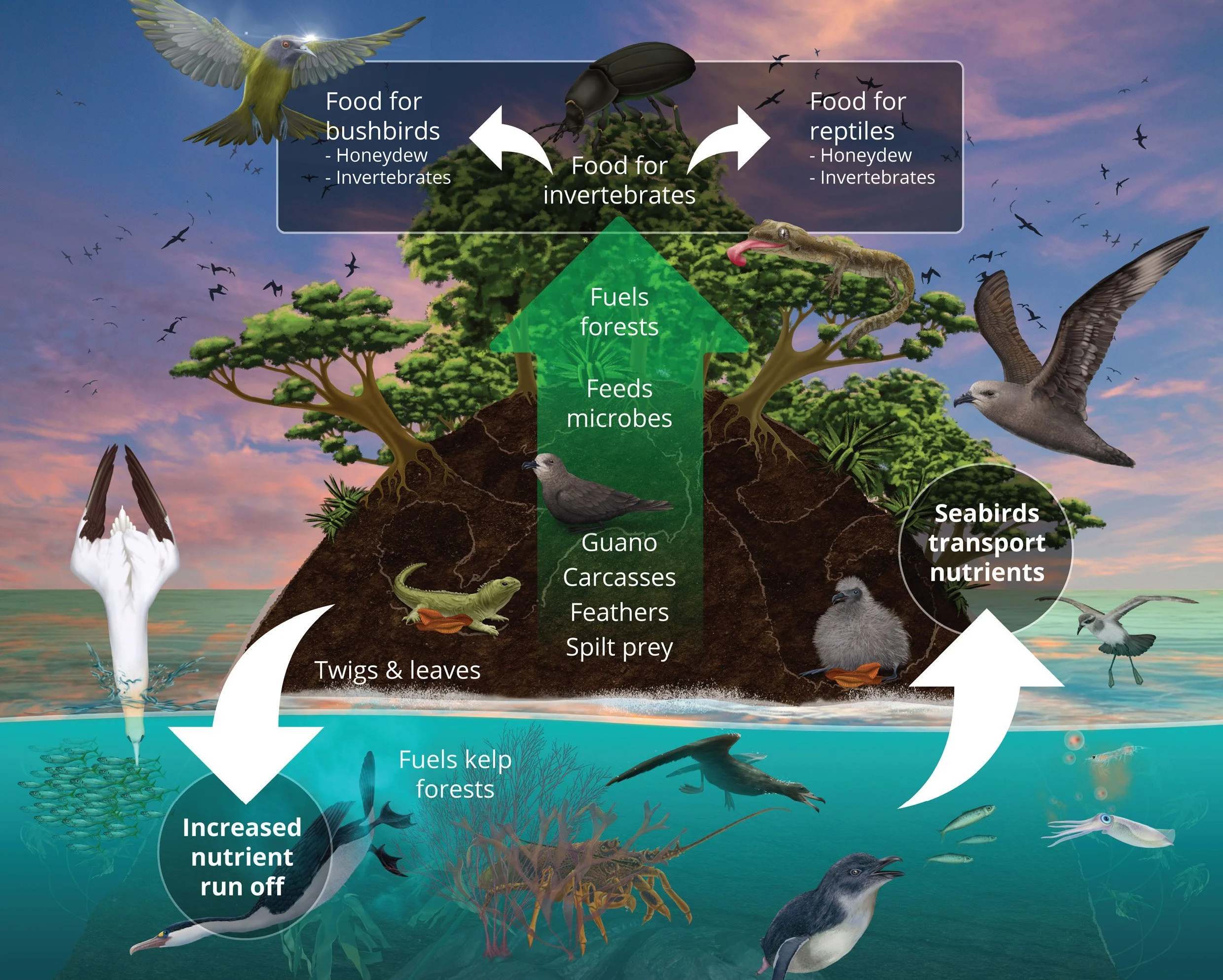
With the return of seabirds, connections between land and sea would slowly be repaired. We know how important seabird nutrients are to our soils and forests but recently we have learnt that these nutrients, on finding their way back to the marine environment, enrich the surrounding reefs and fisheries. We already have an outstanding marine environment around Aotea, but it could be even better if our seabirds were to return.
Our forests would also change. The impacts of rodents and pigs on New Zealand’s forests are not widely known but are profound and pervasive. Their removal from Aotea would start a chain of events that might take another 1000 years to play out. Rates of pollination for some species would improve, others would produce more seed. Seedlings that are currently eaten by rats or pigs would once again take place in the understory and canopy. Over time, the species that have been most affected would regain their dominance in the ecosystem. These changes are also likely to be strongly influenced by the recovery and return of seabirds that are known as ‘ecosystem engineers’ because of the scale of the influence they have on our soils and plant communities.
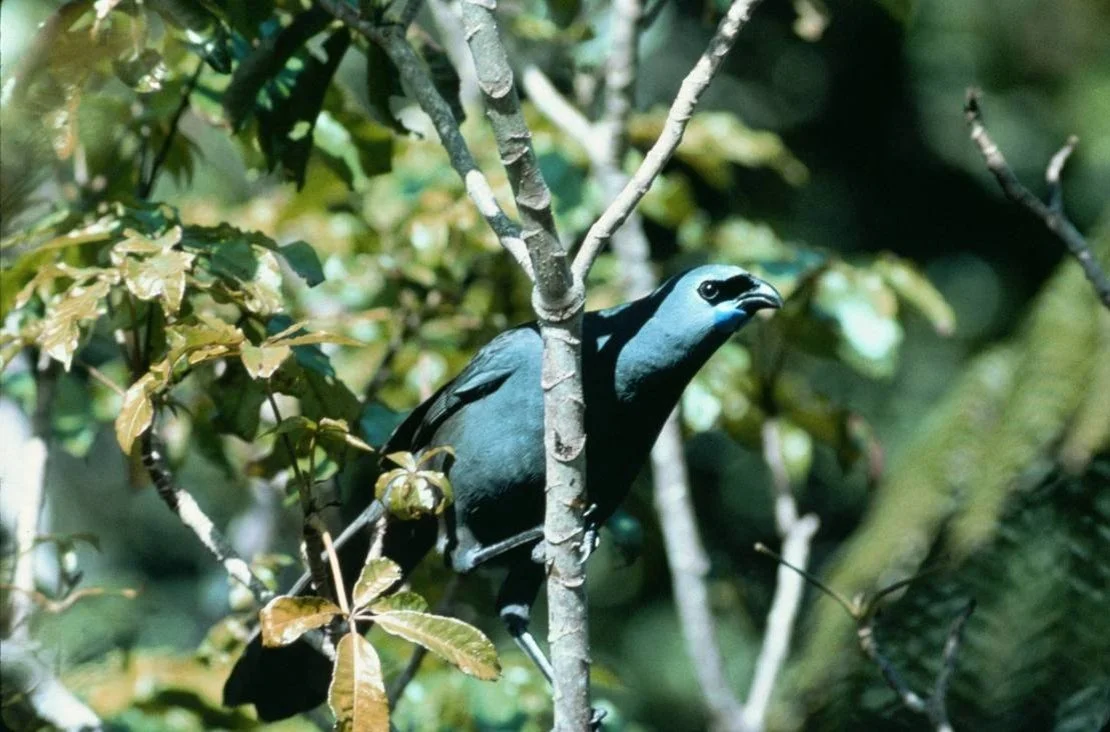
One of the surprising but serendipitous outcomes of rat eradications taking place on Hauturu and Tāwharanui Peninsula in the same year was the arrival and establishment of korimako at Tāwharanui. This was the first time that bellbird had bred in the Auckland region for over 100 years. On Aotea, kākāriki (both red and yellow crowned parakeets) would be back in abundance and making their presence felt along with robins and pāteke. It would also open the door to return species that were once on Aotea such as kōkako, kākāpō whiteheads/pōpokotea, riflemen/tītipounamu, hihi/stitchbird, and tuatara. As many of us are aware, the last of Aotea’s kōkako were relocated to Hauturu before they were forever lost. Their return to Aotea is an ambition of Ngāti Rehua and many on the island.
Aotea has the most diverse and intact reptile fauna remaining in New Zealand but it is not what it should be. If rats, feral cats and pigs are removed we would see dramatic shifts in abundance as has been seen on Hauturu. Our geckos and skinks breed slowly but over a period of time would become more numerous and visible. Imagine Chevron skinks in your backyard.
We would also be in for some surprises. This is one of the wonderful things about removing invasive species, there are things that turn up that we don’t even know we are missing. The forest ringlet butterfly an endangered endemic which had never before been seen on Hauturu were recorded after rats were removed. They must have been suppressed by rats and also possibly by wasps and one of the wonderful outcomes of removing rats from Hauturu was the disappearance of wasps. Common wasps mysteriously vanished from Hauturu following rat eradication. This has happened now on other islands but no one has as yet been able to explain why. Surveys on Hauturu two years after rat eradication also found eight new aquatic invertebrates, six mayflies and two caddis flies that had also never been recorded.
Aotea is already, as most visitors describe it, an island paradise, but for those of us with an understanding of what has been lost, there is work to be done. My challenge to us all is to realise the vision of an Aotea free of rats, feral cats and feral pigs. The investment required will be significant and the work hard and at times unenjoyable but once accomplished the dividends will never stop coming.
Richard Griffiths worked for the Department of Conservation (DOC) for 13 years specializing in the field of threatened species recovery, island restoration, pest eradication and biosecurity. During his time with DOC, Richard led some of the world’s most challenging pest eradications including the removal of Pacific rats from Little Barrier Island and the eradication of eight invasive species from Rangitoto and Motutapu islands. He was also a member of the Department of Conservation’s Island Eradication Advisory Group and for a time the leader of the Stitchbird (Notiomystis cincta) Recovery Group which spearheaded the species’ successful reintroduction to the New Zealand mainland after a 120 year absence.
Richard now works for Island Conservation for whom he manages a team of project managers and island restoration specialists whose focus is restoring islands for nature and people. In addition to supporting other projects, he and his team have successfully removed invasive species from more than 100 islands within the Pacific. His team’s efforts have contributed to the recovery of threatened ecosystems and biodiversity and have improved the livelihoods of a number of Pacific Island communities.
Acknowledgements
Thank you to Barry Scott who encouraged me to write this article and Joanne O’Reilly who extended the invitation to attend the, as always inspiring, Aotea Ecology Festival. There are so many others on Aotea that I am grateful to. You inspire me through your work and vision.
References
-
Wade, L., & Veitch, D. (Eds.). (2019). Hauturu: The history, flora and fauna of Te Hauturu-o-Toi / Little Barrier Island. Massey University Press. ISBN: 978-0-9951095-8-2