
Ngā Huhua | Abundance: New exhibition shines a light on Te Moana-nui-a-Toi
KATE WATERHOUSE (Chair of AGBET)
Opening at the NZ Maritime Museum with a pōwhiri for Ngāti Rehua whānau in November, Ngā Huhua | Abundance—the Lifeforce of Te Moana-nui-a-Toi is a story about the incredible diversity of life in the waters around Aotea. A partnership with Ngāti Rehua Ngātiwai ki Aotea was new territory for the Museum but it has yielded a beautiful result, which can be enjoyed free for Aucklanders until July.
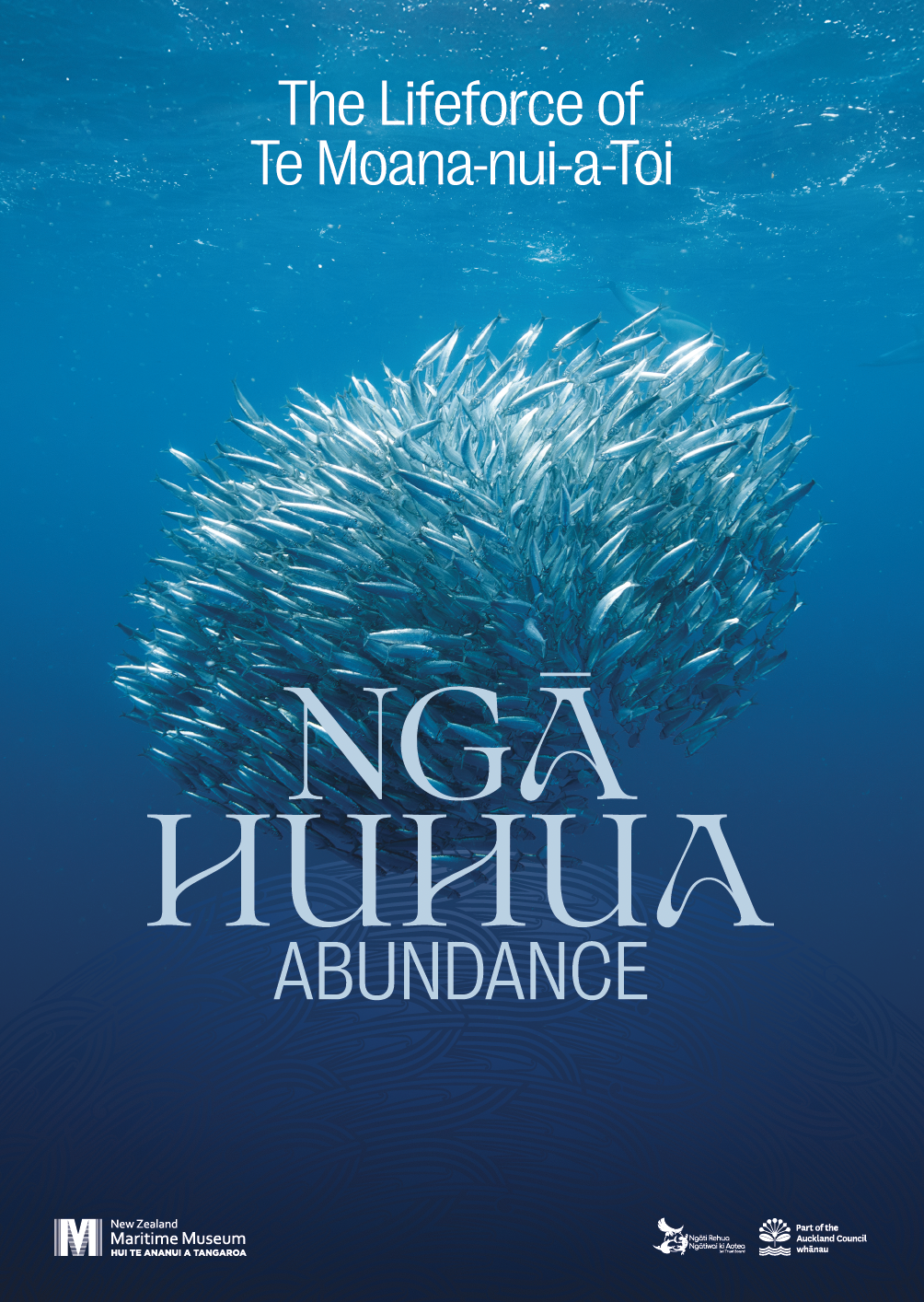
Barrier people will recognise some familiar faces in the video kōrero on wall mounted iPads, speaking about the significance of this moana and the changes needed to return it to abundance. Alongside these are awesome underwater images by Richard Robinson and footage of everything from mackerel (hautere) to mako sharks, to honu (turtles) and maki (orca), which were shot by Steve Hathaway. There’s a serious manta ray angle (no spoilers) and look out for gorgeous artwork by Jade Beazley, and weavers Joelene Nepia and Margaret Ngawaka, along with taonga from the descendants of Toi Te Huatahi. He was the first of the great navigators to arrive on Aotea’s shores around 1250 AD and the outer Gulf still bears his name.
World famous as a productive ocean space, every spring the conditions for that abundance are created. The exhibition paints a picture of the oceanography, seasonal changes and plankton communities that underpin this productivity and make it a magnet for megafauna – like the returning humpback whales, false killer whales, pilot whales and manta rays—even whale sharks and sunfish. Marine biologist Olivia Hamilton described this in Environmental News 46, three years ago.
DOC Ranger, local Sarah Dwyer knows the false killer whales (Pseudorca crassidens) that come in huge social groups to cooperatively feed each year with bottlenose dolphins (Tursiops truncatus). Sarah is delighted that, 25 years after it was created, the Hauraki Gulf Marine Park now has 6% of its area set aside in High Protection Areas. It’s nowhere near enough, and the celebrations at the Royal NZ Yacht Squadron on 3 December hosted by DOC and the Hauraki Gulf Forum were muted.
ABUNDANCE HOTSPOT
The outer Hauraki Gulf, Te Moana-nui-ā-Toi— is a world-renowned biodiversity hotspot supporting a diverse marine megafauna community. The Gulf is famous for the Bryde’s whale and the commonly encountered dolphin species. Yet, our only national marine park is also home to one-fifth of seabird species, one-fifth of whales and dolphin species, various large shark and ray species, large migratory fishes, turtles, and seals. The Gulf’s long coastline and offshore islands, strong currents, and high primary productivity provide the ocean’s giants with critical habitat seasonally or year-round.
Te Moana-nui-a-Toi is the deepest two-thirds of the marine park. It is also one of most heavily fished ecosystems in Aotearoa, where bottom-trawling and dredging have damaged much of the seafloor, including reefs that Opo Ngawaka recalls used to stretch from Aotea to Hauturu. Te Moana-nui-a-Toi is literally being fished to death. You will barely see a work up these days – a far cry from the past, when clouds of gannets, petrels and shearwaters signalled a feeding frenzy had kicked off below. Researchers have found that workups are now less frequent and often last a few minutes, compared with 30-40 minutes and have diminished in size and density.
A two-minute animated workup in the Ngā Huhua exhibition gives you a sense of what it might be like to be in the middle of one of these “multi species feeding aggregations”.
It’s 50 years since Goat Island was made a no take marine reserve. Biomass (total mass of living organisms) within the marine reserve is five times more than it was 40 years ago and tāmure (snapper) are on average 6 cms longer than outside the reserve. Snapper biomass has increased by 800% since the Poor Knights Marine Reserve became a no-take area in 1998.
These results clearly show what can happen when we leave the ocean alone to recover. And Te Moana-nui-a-Toi needs a buffer because of the changes a warmer climate will bring. Three years ago the Gulf had just experienced the worst marine heat wave ever recorded. Since then 2024 saw the highest sea surface temperatures ever recorded globally.
Other stressors are lining up to reduce mauri (lifeforce). Microplastics is one – you can’t see them but they’re here. They wash off our clothes, they come from plastic as it breaks down, end up in the ocean, where they are mistaken for food. In Te Moana-nui-a-Toi there is already plastic in the food chain. It could be through krill eating plastics and then being eaten by whales or schooling fish eating krill and being eaten by predatory fish like haku/kingfish or sharks.
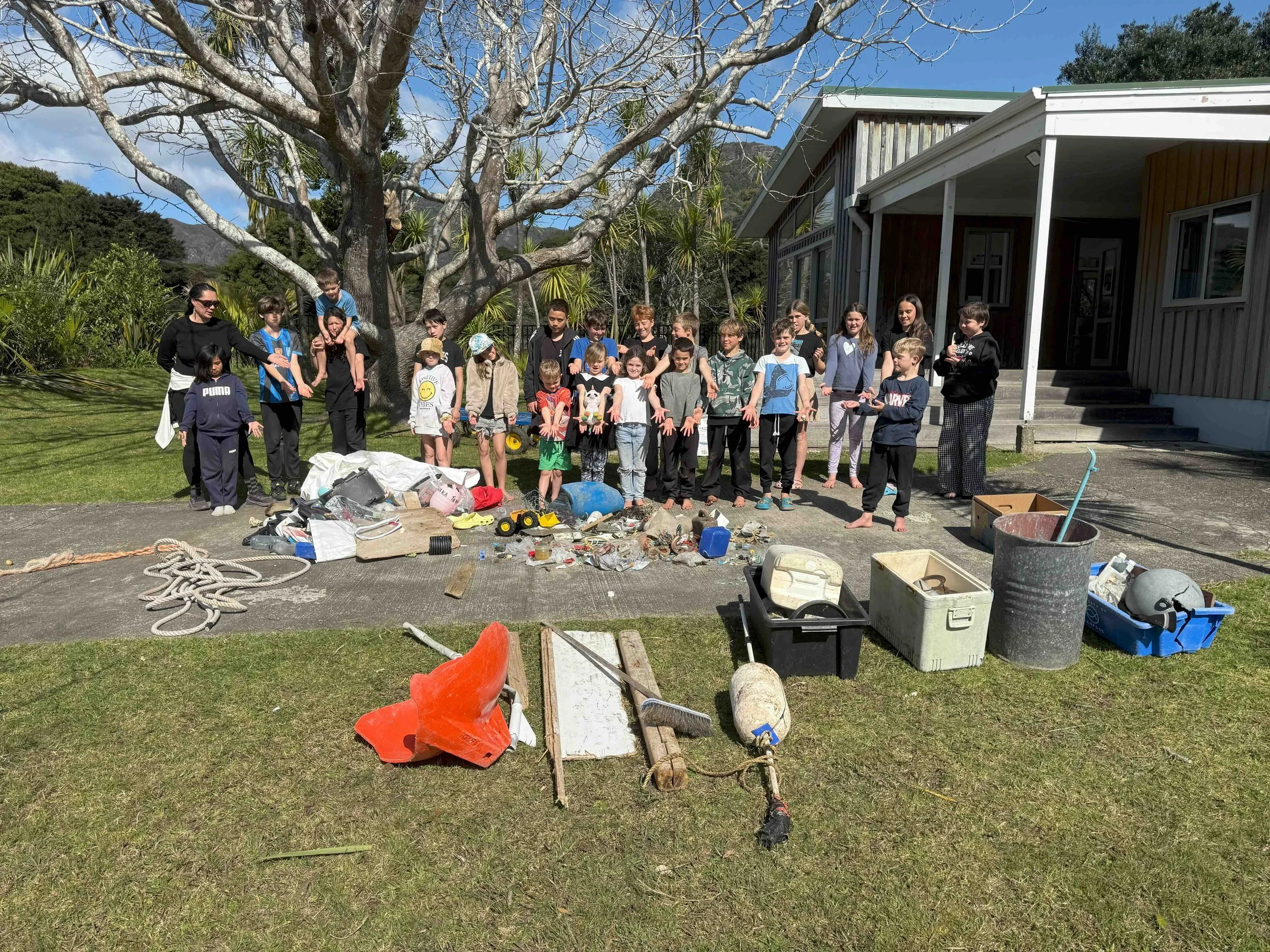
Okiwi Kura senior students got to visit Ngā Huhua on Dec 5th and see themselves - and a selection of their plastic collection from Whangapoua beach on the wall in the museum.
There is nothing on Earth more important than the ocean. Covering 70% of the planet’s surface, it produces more oxygen than all trees, absorbs a third of carbon, and it keeps the planet cool, absorbing 90% of the heat it generates.
Climate scientists forecast marine heat waves to be more common and the ocean to become more acidic. Phytoplankton (the tiny algae that are the base of the food web) already absorb more carbon than any living thing on Earth. The ocean is already about 30% more acidic than 100 years ago because of more CO2 in the atmosphere. This means animals like shellfish and krill will find it harder to make shells or to grow to full size.
Added to this, the East Auckland current that warms our waters in summer may weaken, and wind patterns may be more Easterly which means less upwelling of nutrients to power up the food chain. With fewer krill and plankton everything else has less to eat. Whales, dolphins and fish, sharks and rays, can leave in search of food. But small seabirds like blue penguins/kororā, petrels and prions, will go hungry. Other native species such as bull kelp may die off if they can’t adapt fast enough to heat.
Warming water already means species like sub-tropical mahimahi (dolphin fish, often sighted east of Rakitū) will keep coming in search of prey. The invasive long-spined sea urchin, Centrostephanus rodgersii, which can live and grow to 40-50m, deeper than kina, has already made it to the Mokohinau Group. Like kina, without predators it will polish off seaweeds that shelter reef fish and other life and disrupt the food web, as seen in southern Australia. The University of Auckland is leading efforts to stop this the same thing happening here. We’ll need eyes in the water around Aotea looking for invasive arrivals, whether it is exotic Caulerpa or the long-spined sea urchin, to protect the small pockets of abundance that we have left.
The Aotea Great Barrier Local Board, Ngāti Rehua and the community are advocating strongly for more local controls on crayfish (kōura), before it’s too late, as it might be for scallops (tipa). All the signs are that we need to go further if the abundance of the past, the tides of trevally, the sea pink with krill, is to be seen again, or remembered as more than a story. The return of small numbers of humpback whales along their old pre-whaling migratory paths to Antarctica gives many people hope that recovery is possible.
As whale specialist Rochelle Constantine says in one of the iPad interviews you can watch in the Ngā Huhua exhibition, your choices matter. “Do one thing for the ocean every day… that’s how change happens.”
References
-
Olivia Hamilton, The importance of the Aotea Marine Environment to the Gulf’s Marine Megafauna Community https://www.gbiet.org/en46-the-importance-of-the-aotea-marine-environment
-
Sarah Dwyer and Kirsty Prior, interview with Barry Scott https://www.gbiet.org/en47-cetaceans-around-aotea
-
Opo Ngawaka, personal communications, 2025
-
Kate Waterhouse, Editorial, A Time to Act. Environmental News Issue 46 Winter 2022. https://www.gbiet.org/en46-editorial-kate-waterhouse
-
Dr Nick Shears, personal communications, 2025 and https://www.researchgate.net/publication/378895401_Long-term_warming_and_recordbreaking_marine_heatwaves_in_the_Hauraki_Gulf_northern_New_Zealand
-
Gostischa J, Massolo A, Constantine R. (2021) Multi-species feeding association dynamics driven by a large generalist predator. Frontiers in Marine Science 8:739894.
-
Zantis LJ, Bosker T, Lawler F, Nelms SE, O’Rorke R, Constantine R, Sewell M, Carroll EL. (2022) Assessing microplastic exposure of large marine filter feeders. Science of the Total Environment 818:151815.
-
Erik Behrens, Earth Sciences NZ https://livenews.co.nz/2025/10/15/climate-new-research-to-understand-the-impact-of-marine-heatwaves-on-fisheries/