
Friends of Niue
BARRY SCOTT (Editor Environmental News)
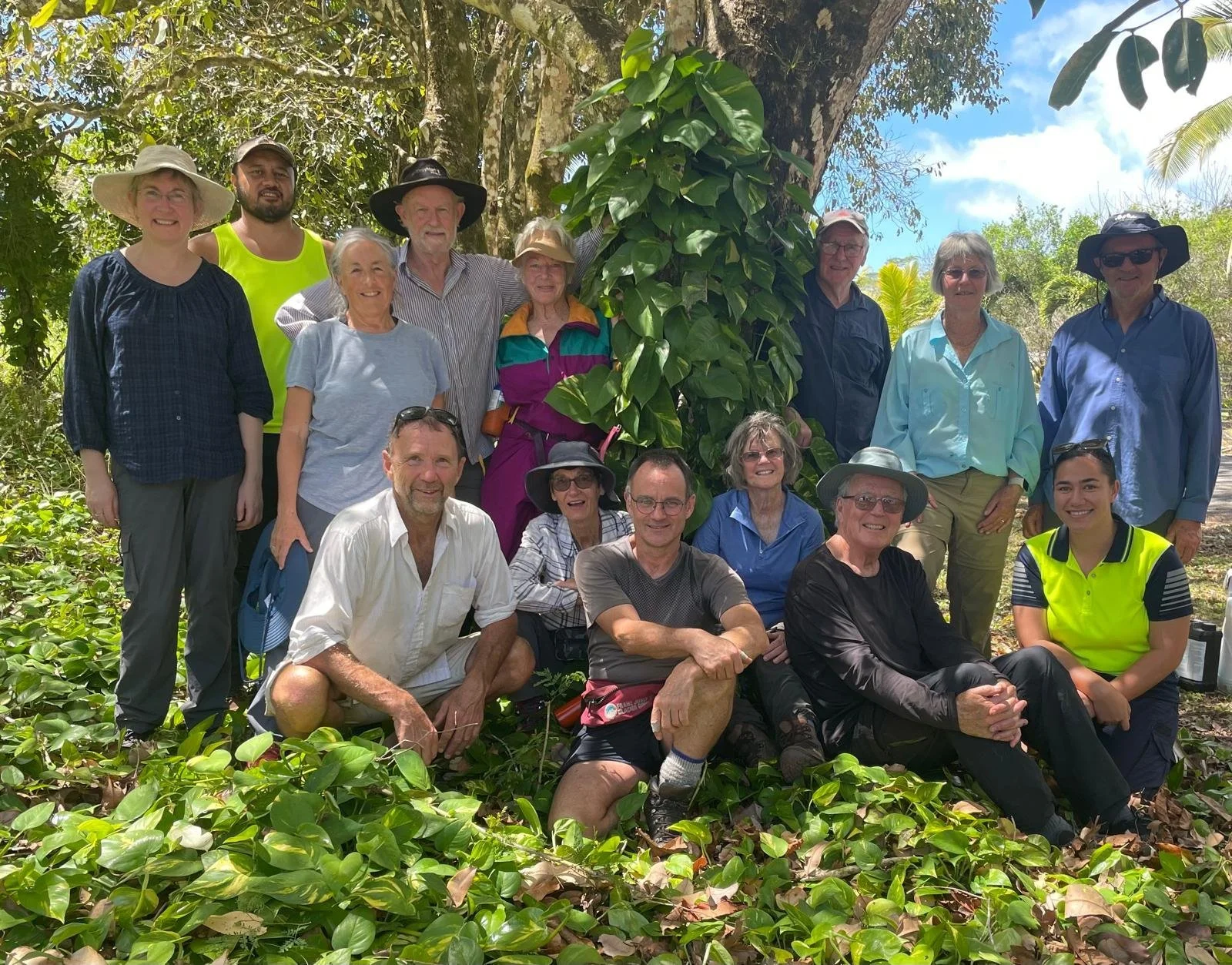
In September 2025 a group of 12 of us went up to Niue as volunteers to help the Department of Environment remove the highly invasive African Tulip Tree (Spathodea campanulata)(1) at three sites across the island. The inspiration for formation of ‘Friends of Niue’ came from an article in New Zealand Geographic by Pete McKenzie entitled ‘The Fight for Niue’(2). While reading this article I recalled from a visit to Lord Howe Island in 2023 that a self-funded group of volunteers, ‘Friends of Lord Howe Island’(3), had been set up there in 2001 to assist the Local Board with weed eradication and other conservation projects. My immediate thought was ‘why not do something similar for Niue’.
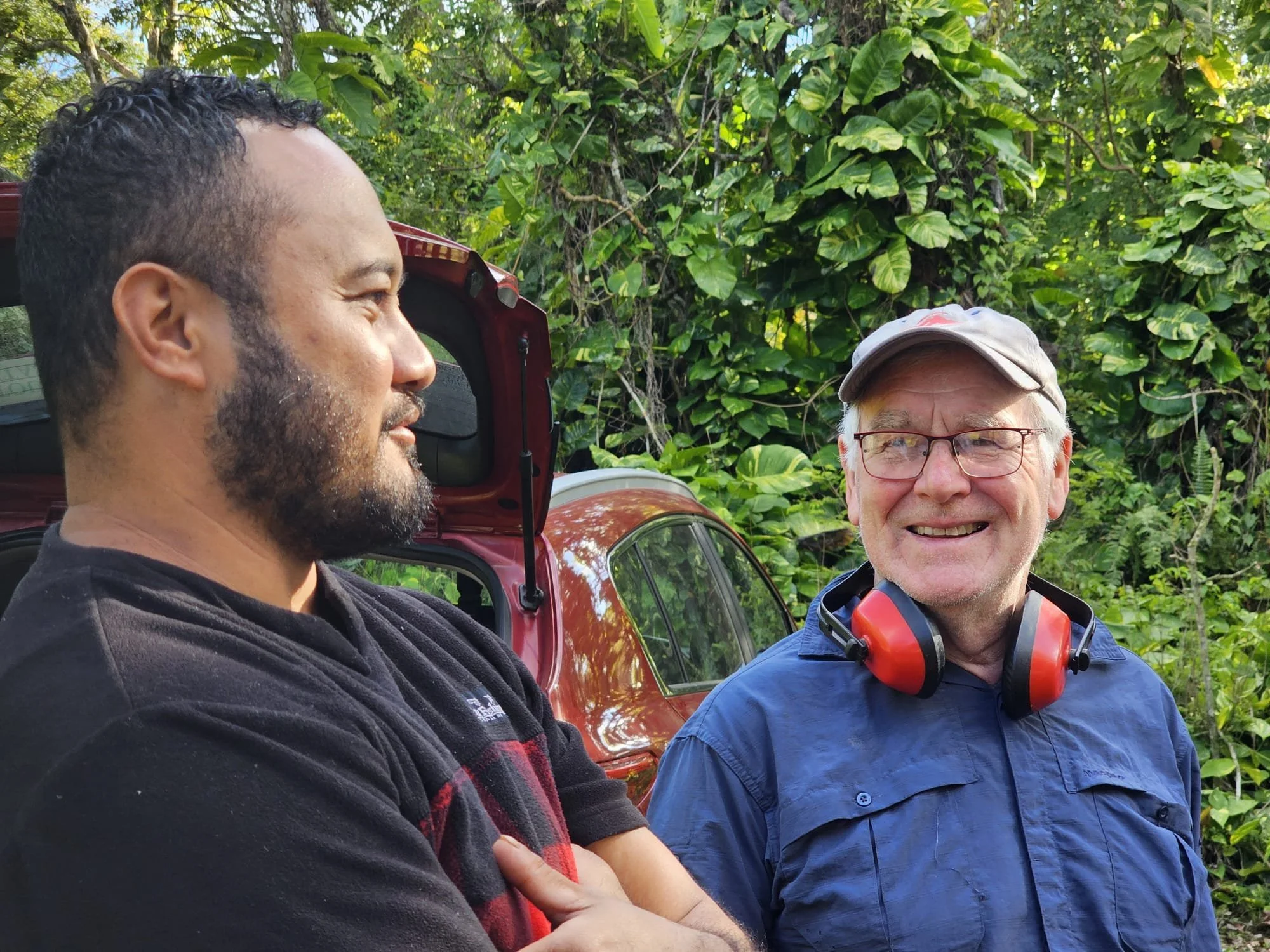
To pursue the ‘Friends of Niue’ concept I first contacted Pete who connected me with Huggard Tongatule, Biodiversity and Conservation Officer for the Department of Environment who featured in Pete’s article and asked him what he thought of the idea. Huggard wrote back almost immediately. “Your ‘Friends of Niue’ concept is a brilliant idea and something I have discussed in the past with various individuals on how we can set up something like this.”
After talking to Huggard I put together a flyer which was distributed to the AGBET membership list, the Palmerston North Tramping & Mountaineering Club, and various friends, old and new. Within a month we had a group of 12 people from Palmerston North, Nelson and Aotea Great Barrier Island, all keen to sign up. I think the combination of some volunteer work with the opportunity to snorkel or dive in the beautiful clear waters of Niue to see humpback whales and their young was a big drawcard. Given the surface of this island is predominantly rocky limestone there is little sediment that washes into the surrounding ocean so the waters are among the clearest in the world with clear visibility to 50 m or more.
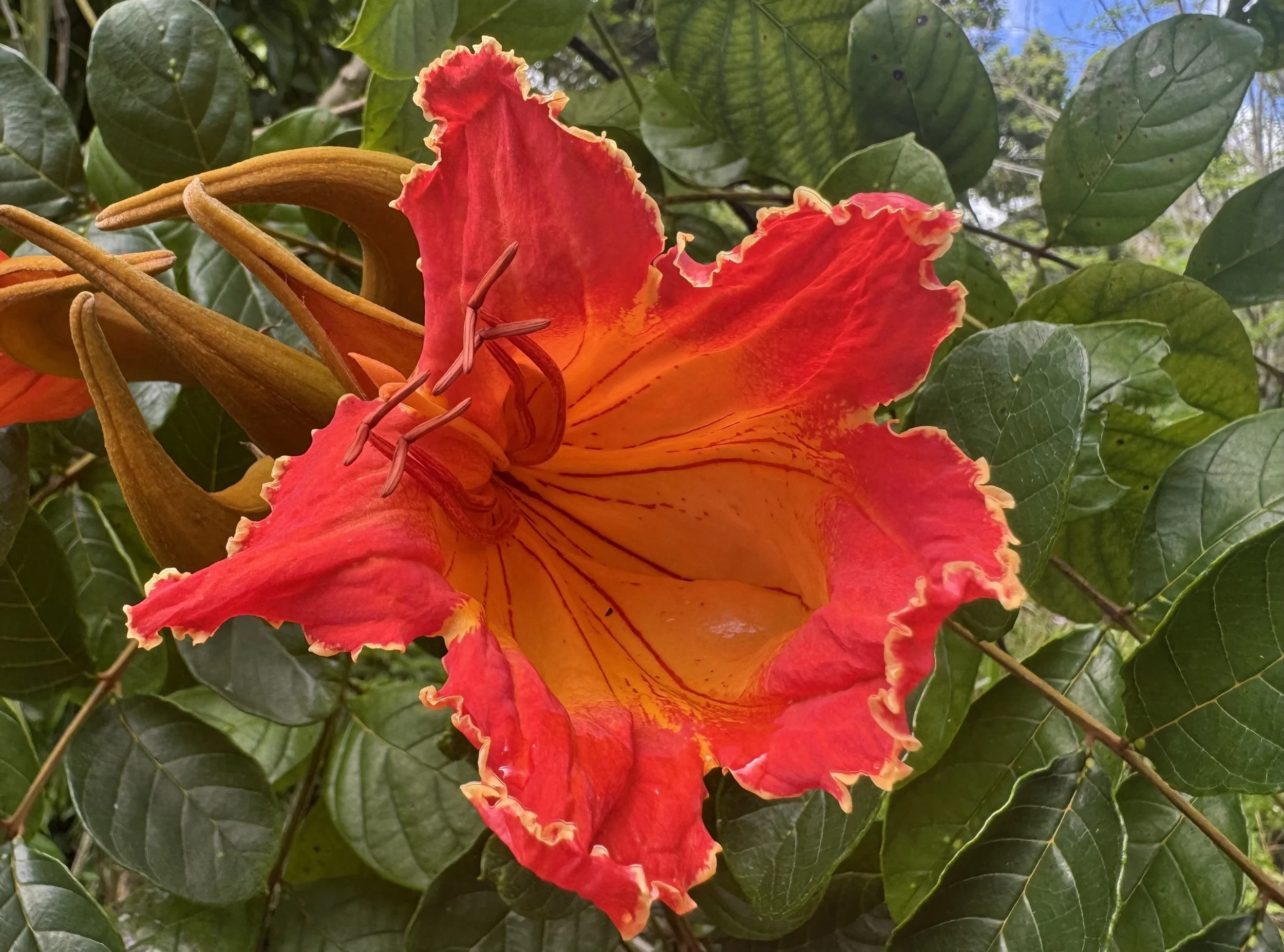
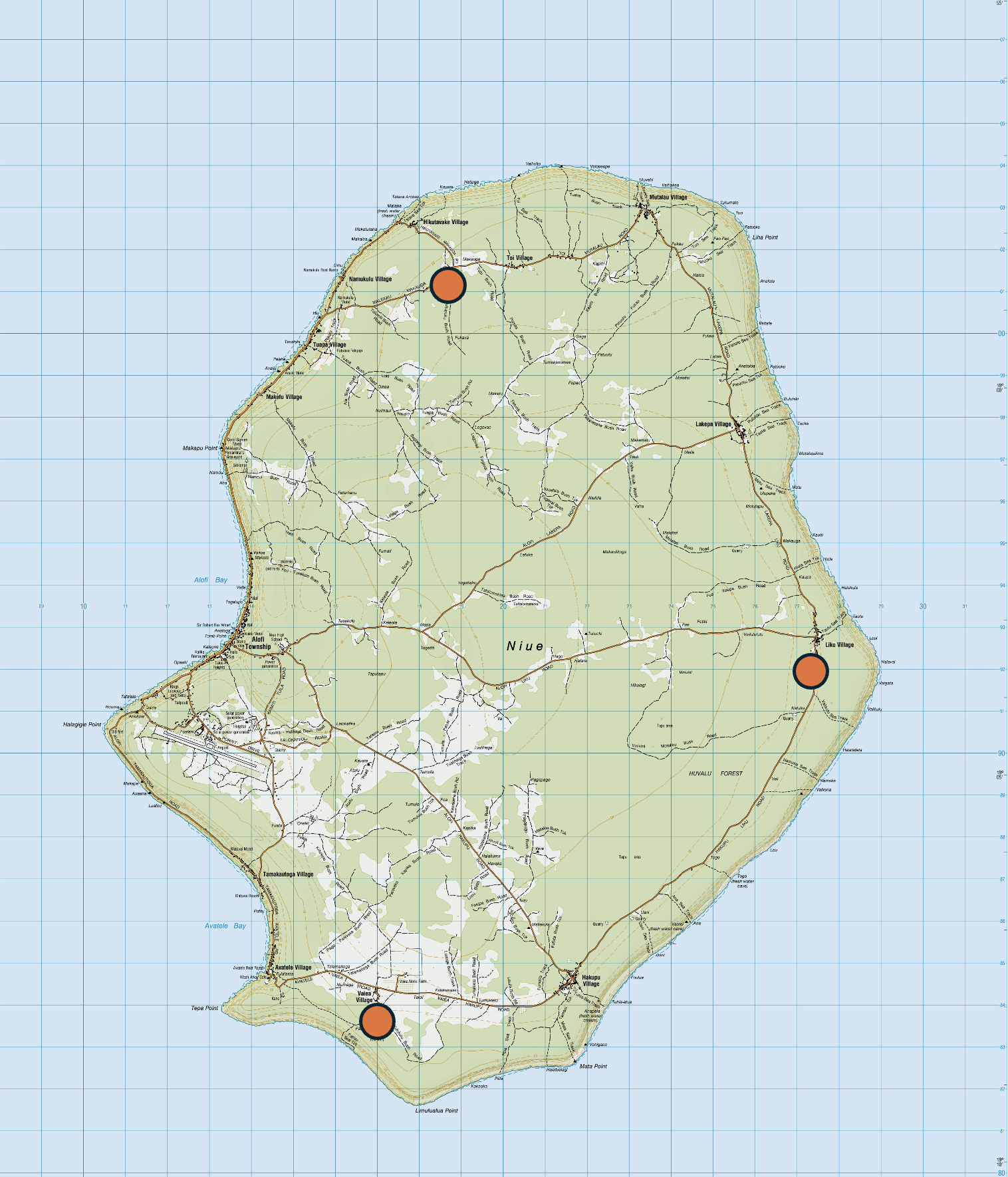
The day after arriving in Niue I went to meet Huggard, collect the tools and gear (electric chainsaws and herbicide) I had shipped up in June for the work, and went to inspect our first work site at the old village site of Vaiea, which had been abandoned for a new site in the 1940s. Given most invasives first establish around human settlements, Vaiea was no exception, with several exotic plants growing around this site with the most notable being the African Tulip Tree. One look at the beautiful flowers and you can see why people planted this tree on Niue and many of the other Pacific Islands. Originally from West Africa, African Tulip Tree is recognised as one of the world’s worst alien plant species and ranks among the top 30 terrestrial invasive species. Initially introduced to many Pacific islands as an ornamental plant, this fast-growing evergreen tree now poses a significant threat to island biodiversity, infesting rain forests, outcompeting native vegetation, and negatively impacting agricultural production. It produces large quantities of seeds that are easily dispersed but also reproduces by suckering, forming dense thickets. Up to 12,000 plants per ha have been recorded in Fiji(4). While it is now impractical to eliminate from many of the Pacific Islands by mechanical methods combined with herbicide treatment, it is still confined to just a few small sites at Niue. Hence the recommendation from Huggard that we tackle this one with the long term goal of eradicating it. From aerial (drone) and land based surveys there are currently just three known major infestation sites, all relatively small in areas of a few hectares, raising the real possibility of eradication on a Pacific Island for the first time.
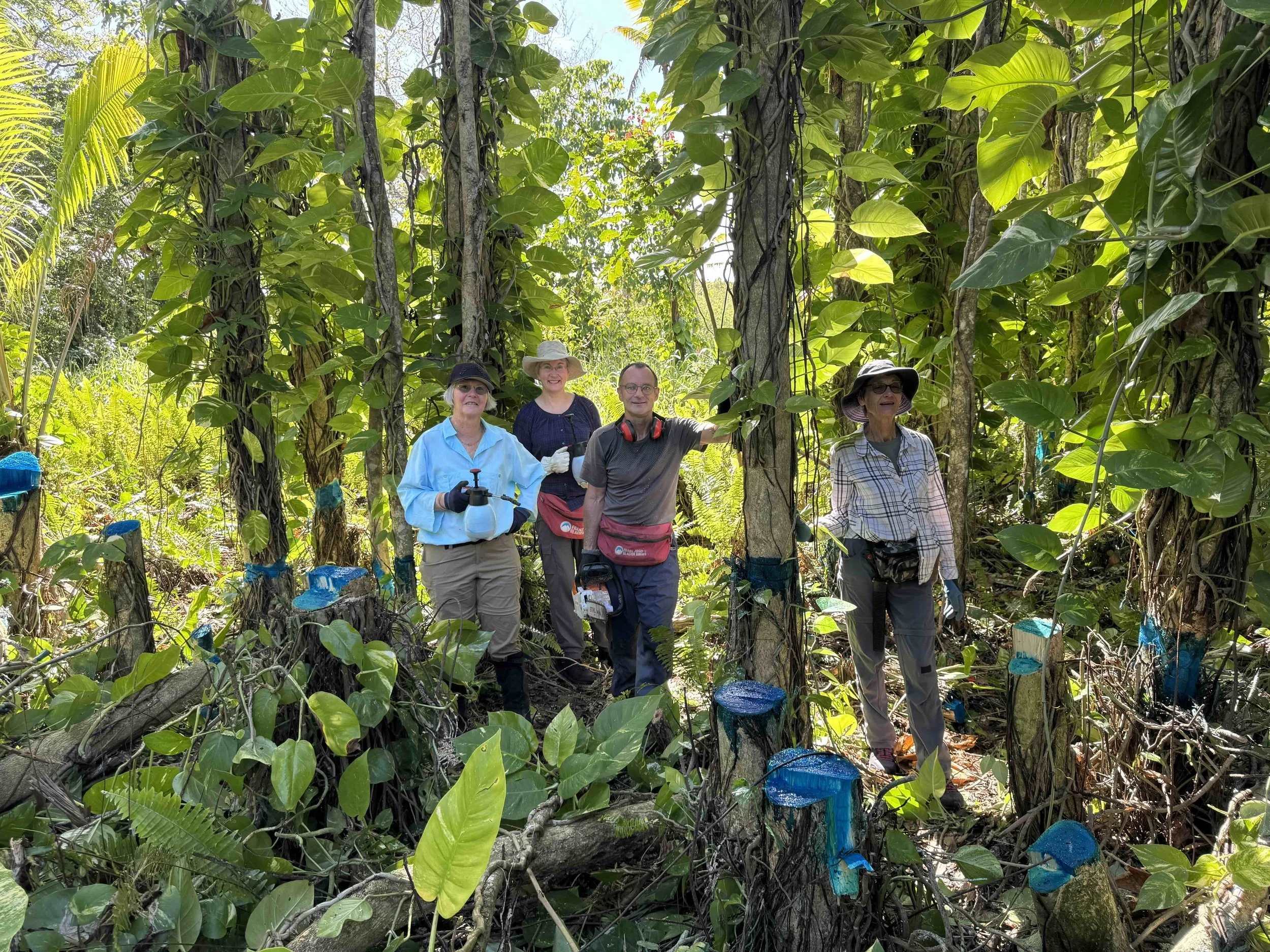
The next morning, after a Health and Safety briefing from Huggard and a quick session on how to identify African Tulip Tree, 19 of us – our group of 12 as well as 7 from the Department of Environment – set to work around the old village site with electric and petrol chain saws, slashers and secateurs to cut and paste or spray slashed trunks of every African Tulip Tree we could find, from small seedlings through to large trees. We worked in pairs with one person cutting and the other pasting herbicide gel on both cut ends. Morning tea of cold Raro and bountiful delicious snacks under the marquee were a welcome respite from what was pretty hard work. By lunch time we had ‘smashed’ this site with cut African Tulip Tree lying everywhere, and we were again presented with Niuean quantities of food. After lunch we all headed back to our accommodation at Namukulu Cottages for a rest before dispersing to one of the many sites along the coast for swimming or snorkelling. Limu pools and Matapa chasm were close by and great sites for both activities.
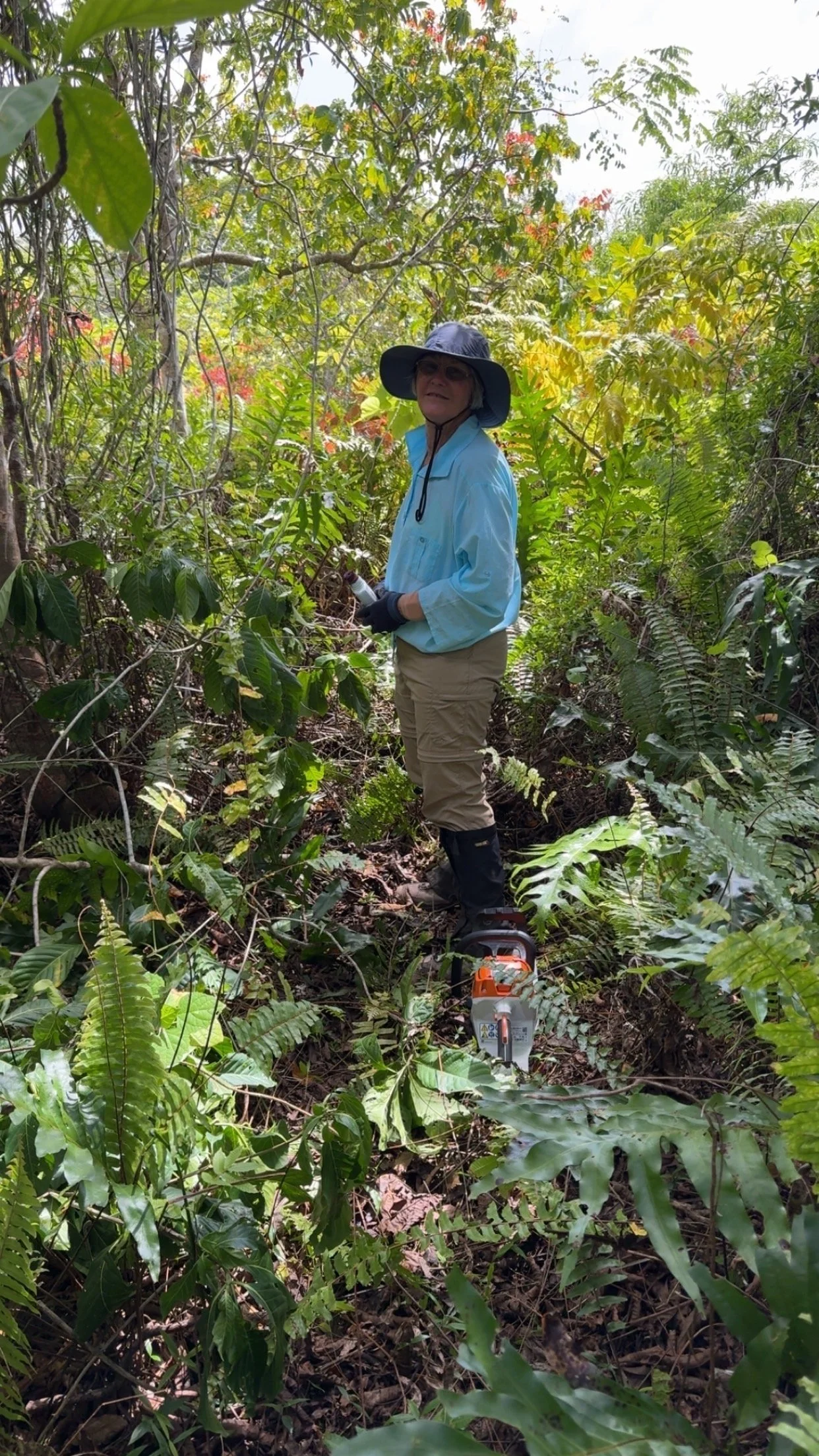
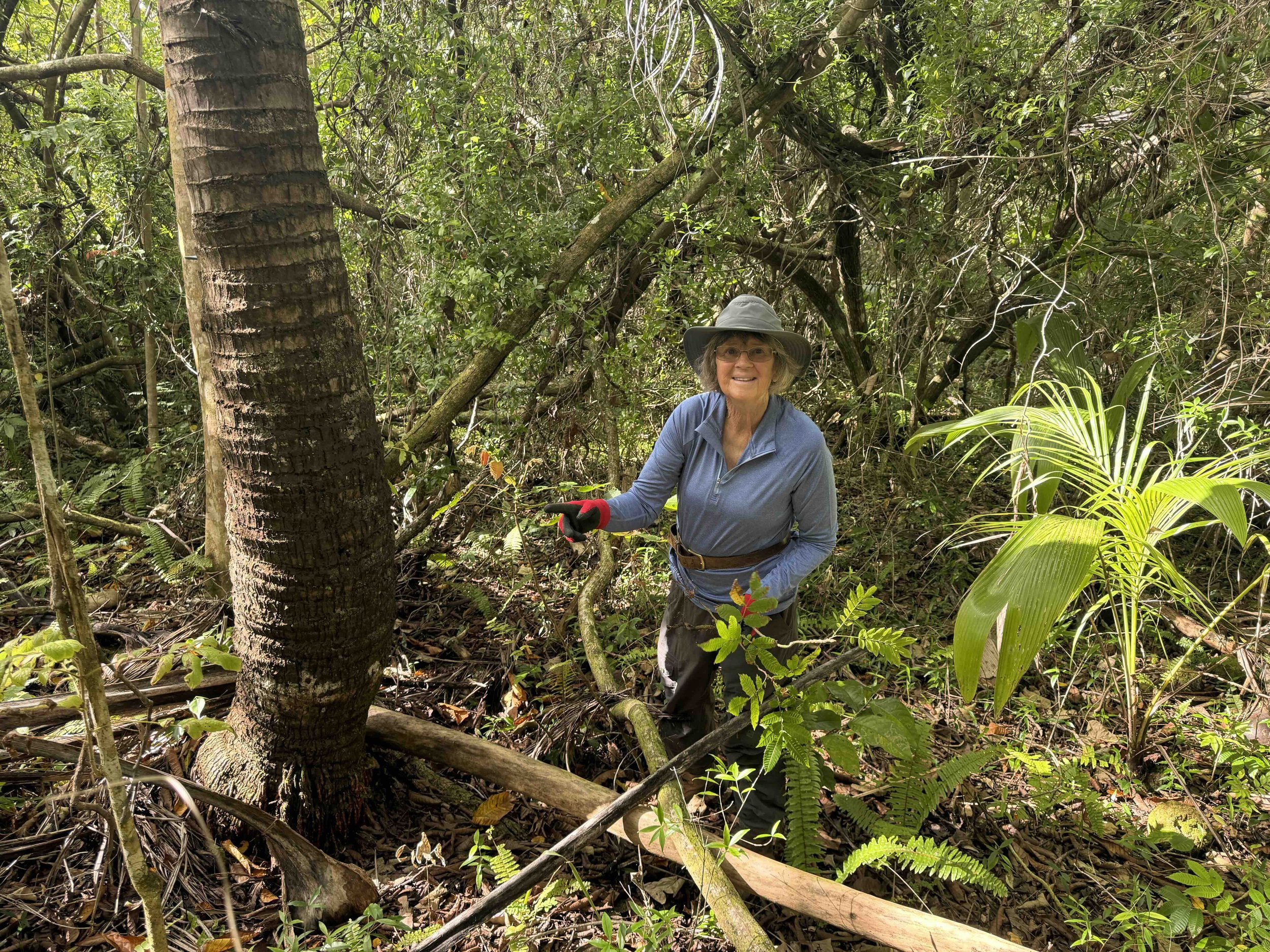
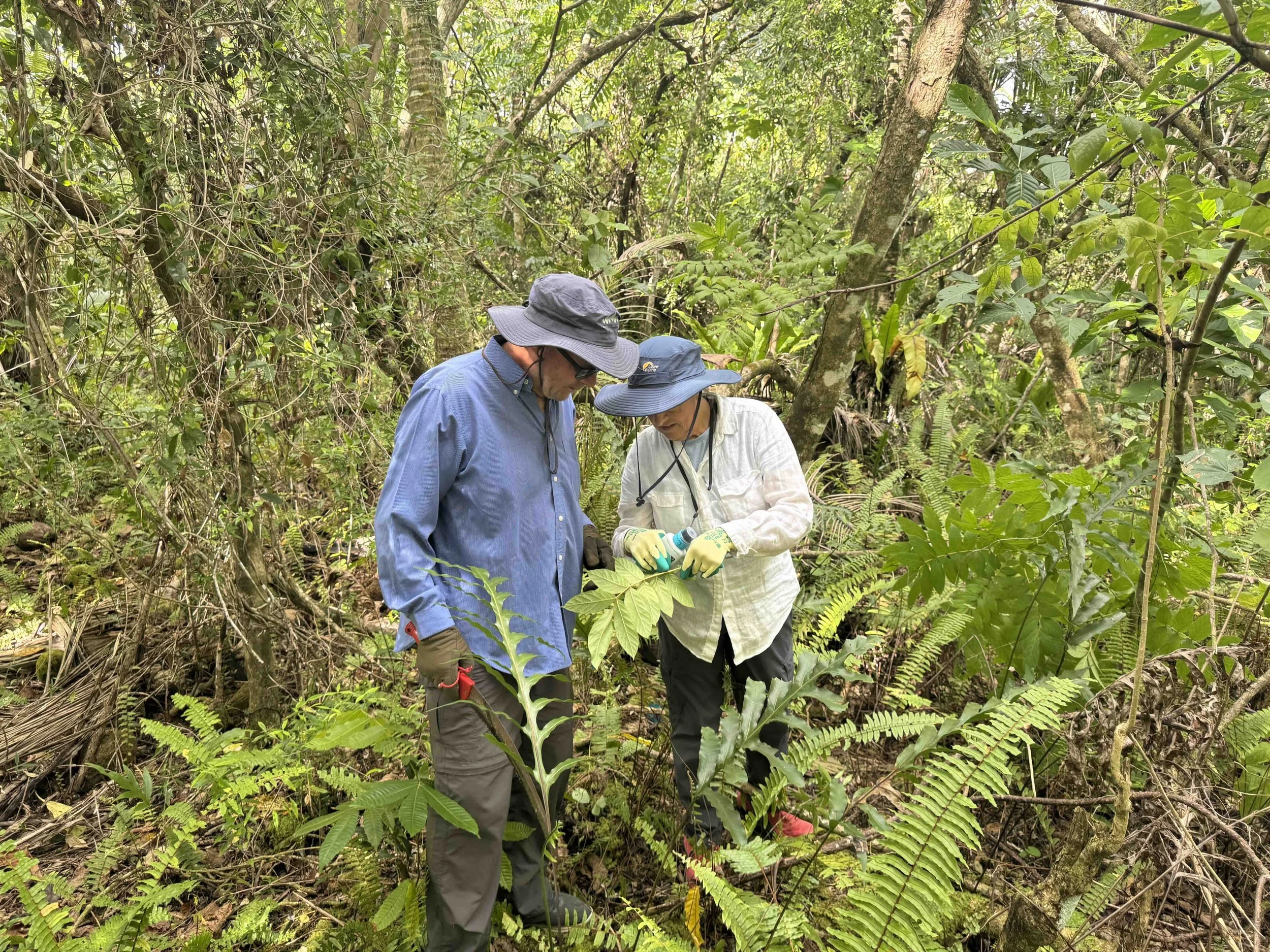
On the second day (Thursday) we went back to the old Vaiea village to remove the remaining plants and grid walk the entire site to ensure we had not missed any trees or seedlings. The seedlings were relatively easy to identify with their distinctive pubescent stems and leaves but the taller trees were a bit trickier except for those that were still in flower. After morning tea we headed around to Huvalu Forest Conservation Area near the village of Hakupu. Here we were introduced to the most out-of-control plant invasive on the island – Taro vine(5). The Huvalu Forest Conservation Area is owned by two of the adjoining villages of Hakupu and Liku, who have agreed to set this area aside for protection of the original native forest.
The size and vigour of Taro vine was quite confronting. Most host trees had several thick vines winding their way to the top. Even cutting the stem at ground level does not kill the vine as it continues to grow as an epiphyte from organic material that accumulates in the crown of the tree. The vine itself is also firmly attached to the trunk. Like African Tulip Tree it was introduced to Niue and other Pacific Islands as an ornamental, possibly first at a resort. It was first described growing in a nursery in the Solomon Islands in 1880 and named Epipremnum mooreense but in 1964 was renamed Epipremnum aureum. Albert Smith noted in 1978 that the only difference between Epipremnum pinnatum and Epipremnum aureum is the former has green leaves and the latter variegated leaves. Recent work by scientists at Manaaki Whenua – Landcare Research using microsatellite DNA analysis showed there is very little genetic difference between the two suggesting that the latter is a cultivar of the former and should be named Epipremnum pinnatum cv. ‘Aureum’(6). Given how widespread it now is on the island the only feasible method for controlling it appears to be a biocontrol agent. A lace bug (Holophygdon melanesica) specific for Epipremnum pinnatum has been identified in Fiji and is due to be released in Niue this year(6).
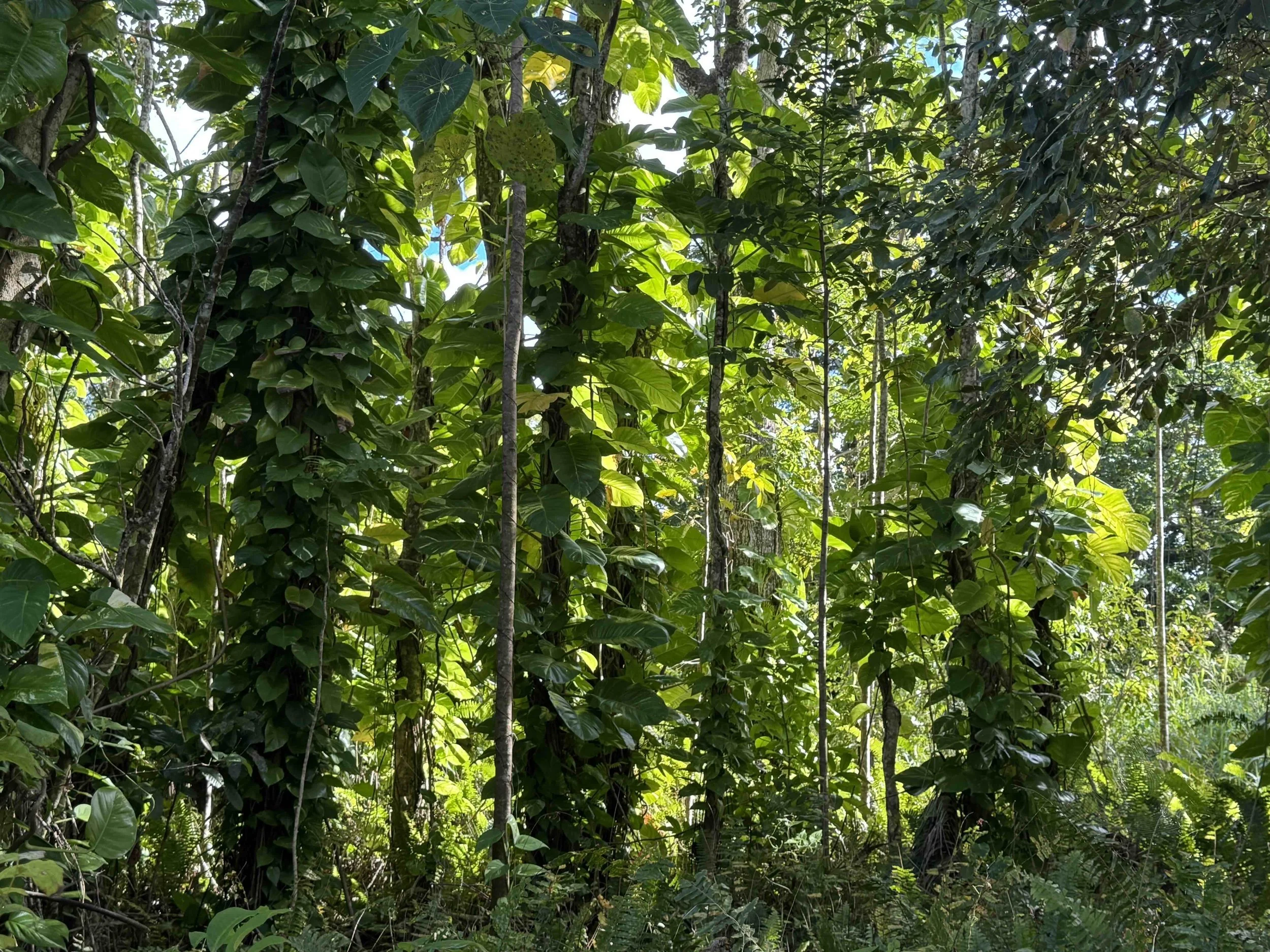
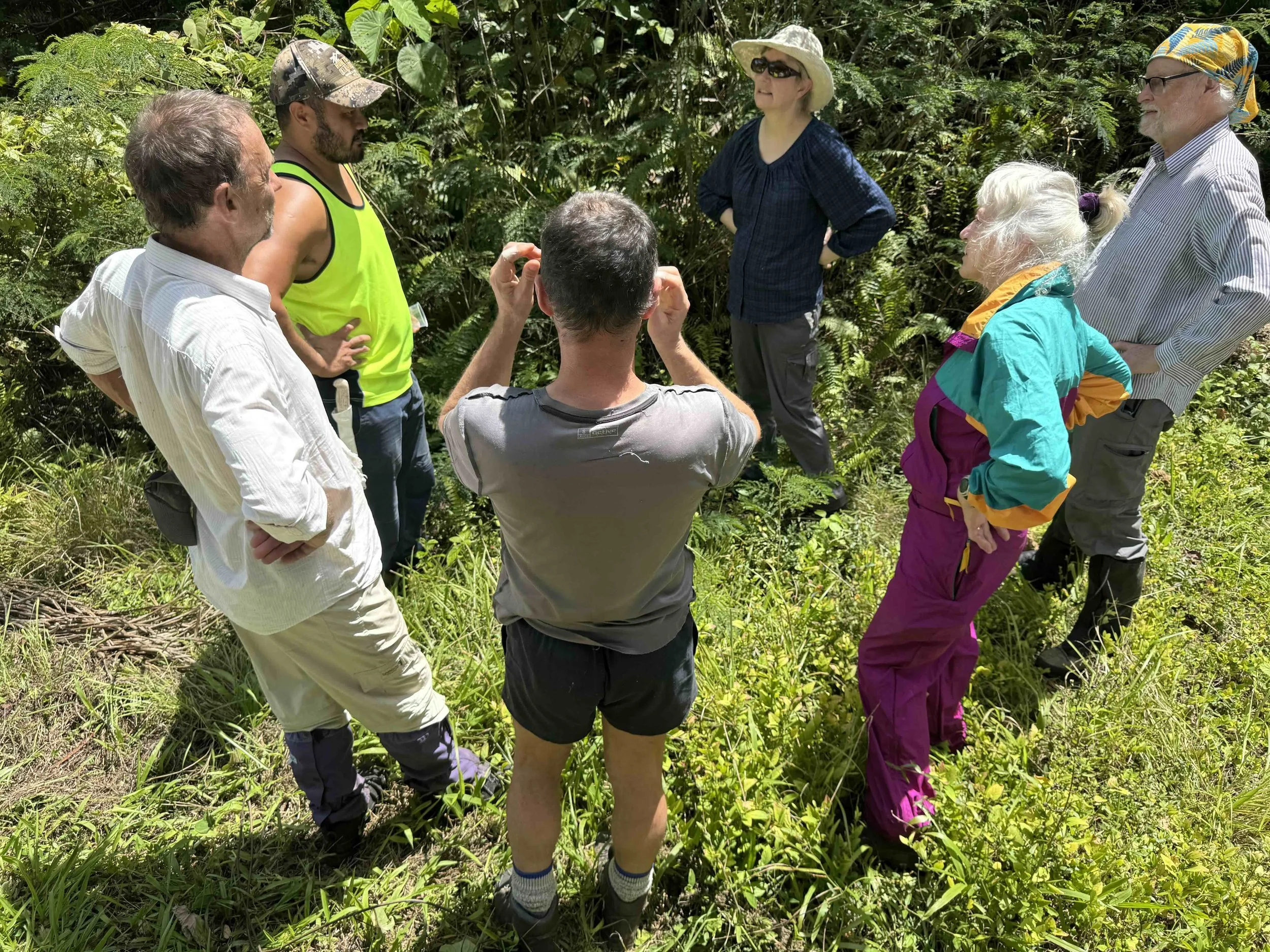
On the third day (Friday) we worked at a site on the side of the road opposite the island Plant Research Station. This was very challenging, with some big African Tulip trees along with Taro vine and other invasives. After morning tea Huggard showed us around the Research Station where they propagate several agriculturally important crops for the island including vanilla, coffee, banana, and coconut. According to Huggard this was one of the original sites from which African Tulip tree spread, as one of the early roles of the station was to propagate exotic species as ornamentals for island gardens. Huggard and his father had both previously worked at the Research Station but its staffing levels are now very low compared to what they were when he and his father worked there. Consequently, many invasives, including Taro Vine and African Tulip Tree, have got away within the boundaries of the station. While removing the African Tulip Trees at this site we noticed that two big trees that had been previously been felled were regenerating, highlighting to everyone that we had to be very thorough in treating all cut ends with herbicide spray or paste. While accessing the trees here was much easier than the ‘jungle’ area across the road there were more plants than originally anticipated, so we agreed to return the following Tuesday to finish this site and to clear the trees at the third major site near Liku village.
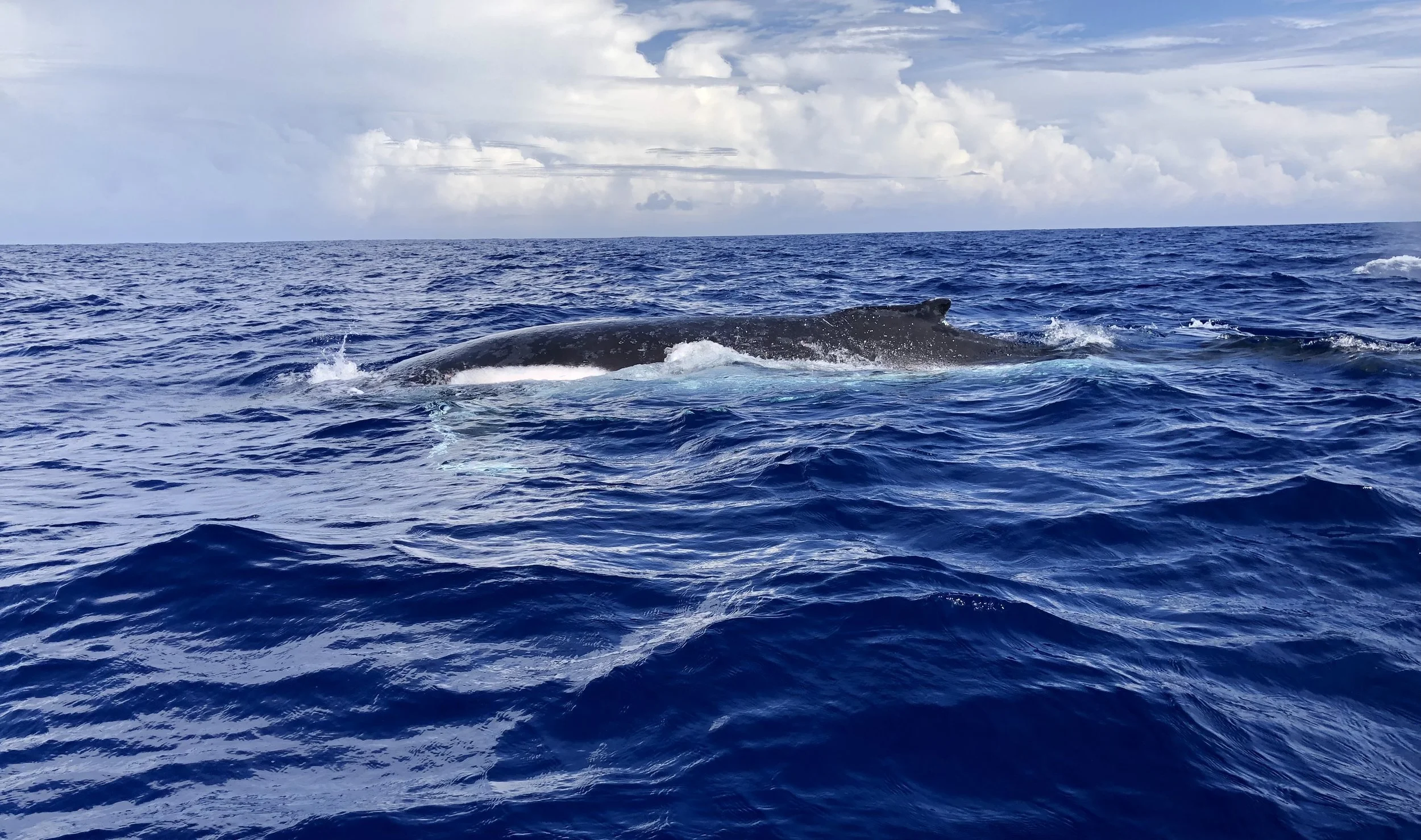
The weekend saw us all out and about exploring the island, with some of us heading out to sea with Niue Blue to snorkel in the beautiful clear blue water and to get up close to spinner dolphins and humpback whales. There was also the opportunity to go fishing which none of us took up but some of our neighbours at Namukulu went out spear fishing. I was fascinated to hear that they did not get to take the fish home. The fish is given to the captain of the boat who returns some cuts for a meal with the remainder going to the Niuean community. This seems a great model for managing the harvest from the sea. Others in the group went to the Tuapa Village show day to see all the wonderful displays of fruit and vegetables, craft and dance. These show days are a well-known tradition on Niue with each of the 14 villages around the island taking their turn at hosting an event. None of the produce is sold until late in the morning after everyone has had the opportunity to inspect and admire the range of produce and products. Sunday is a quiet day on the island as most of the residents attend services at their village church. After church the Washaway Café at Avatele is a popular place to go for fish and chips. They are only open on Sundays. In fact, most of the cafes on the island are open for just 2-3 days during the week enabling business to be shared and for tourists to sample the culinary delights at several different places.
On the island at the same time as us were scientists Peter Heenan and Caroline Mitchell from Manaaki Whenua – Landcare Research. They were collecting coconuts from as many sites as possible as part of the Climate Smart Agriculture and Sustainable Land Management Programme (CALM) funded by MFAT to determine the genetic diversity among coconut populations across the Pacific. The local children were offered a free hand lens in return for a coconut! Peter has spent a lot of time in Niue in recent years working closely with Huggard and others from the Department of Environment to update the flora of Niue as there have been few publications on the flora of Niue since the 1960s. In 1965 Bill (WR) Sykes spent 10 weeks there and collected around 1000 plant specimens, which were deposited in the Allen Herbarium at Lincoln and the Museum of Niue(7). However, much of the Museum collection was lost from the devastation of Cyclone Heta in 2004. The renowned American botanist, Art Whistler from the University of Hawai’i, carried out a biodiversity survey of the Huvalu forest in 1997 and a rare plant survey in 2013(8). More recently Rhys Gardner from the Auckland Museum followed up Syke’s work with an update on the vascular plants in 2021(9). A joint publication by Peter and Huggard for the public on the flora of Niue is to be published early next year, with the potential also for digital plant ID.
We were therefore fortunate to have the opportunity to sit in on a joint seminar by Peter and Caroline on the Monday entitled ‘Coconuts to Orchids’. Having already been in the field for a few days it was great to hear a more detailed account of the flora of Niue and gain some insights into the natural history of this special island. The forest of Niue is quite open but very diverse, which is typical of tropical forests where there is low winter rainfall but high summer rainfall. Current work by Peter shows that there are around 204 indigenous plant species on the island with most of these individual species confined to one genus. Around 20% of the original forest is still intact on Niue, which is much higher than most other Pacific Islands, where population and other pressures have depleted much of the original forest. For instance, Tongatapu (in Tonga), which has a very similar area to Niue (Tongatapu 257 km2 compared to Niue 259 km2) has less than 10% of the original forest. Working in Niue’s favour is the small population of around 1500 people which reduces considerably the pressure on the natural environment and the area of forest cover (which is increasing), but that does have its economic disadvantages.
On the Tuesday of the second week we were back to the Research Station to ‘slay’ the remainder of the African Tulip Trees at that site. By morning tea that site was done leaving the remainder of the morning to deal to the third major infestation in the forest by the roadside close to Liku village. Here there were mainly large trees so the chainsaws roared again. By lunch time this site was also completed, which gave a great sense of satisfaction to the whole team.
As a record of our work Kim Bannister put together a YouTube video that includes interviews with Huggard and I at the start and end of our volunteer work on the island, the crew in action in the forest, and some fabulous footage of adult and baby humpback whales(10). In the wrap up interview Huggard expressed his gratitude for what we had done but also mentioned that any help around predator control, especially feral cats and rats, and other conservation work would also be welcome given their ambition to be predator free in the near future. Maybe there is potential here for some collaboration with Tū Mai Taonga and other conservation groups on Aotea Great Barrier, where there is considerable collective knowledge and experience in trapping both rats and feral cats. Incidentally, Aotea at 285 km2 is of a very similar size to Niue, but with much more complex terrain.
Niue may be a small nation but its vision to put nature at the heart of the economy is unprecedented elsewhere in the world(11). Mona Ainu’u, Minister for Natural Resources, is Niue’s biggest advocate for protecting its forests, reefs and whales. One of its biggest challenges will be protecting its huge economic exclusion zone of 318,000 km2. In September of this year the Niue Ocean Wide Trust received a grant of $US 4 million from the Bezos Earth Fund, which will be used to help protect and sustainably manage Niue’s Moana Mahu Protected Area of 12.7 million hectares(12).
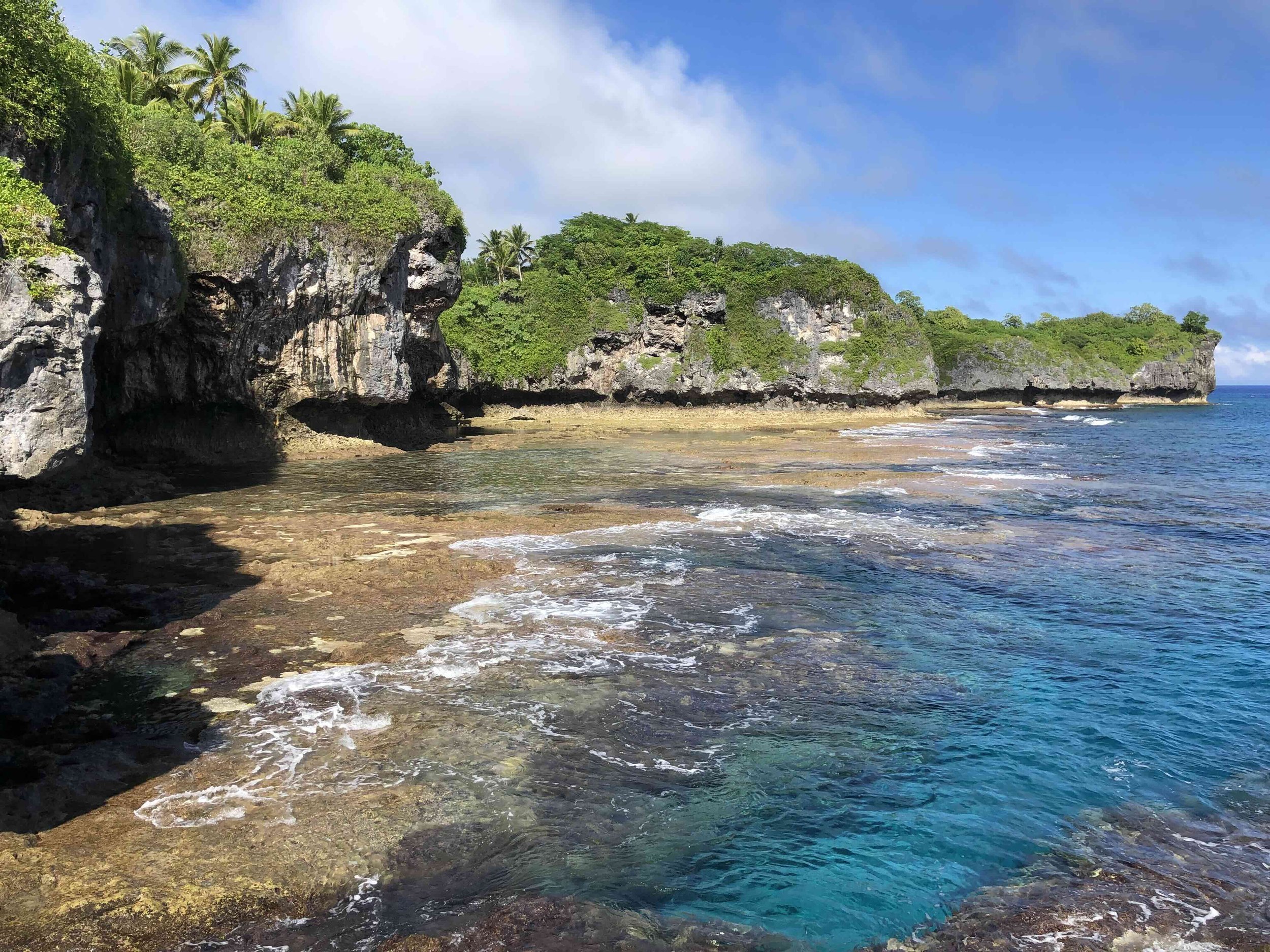
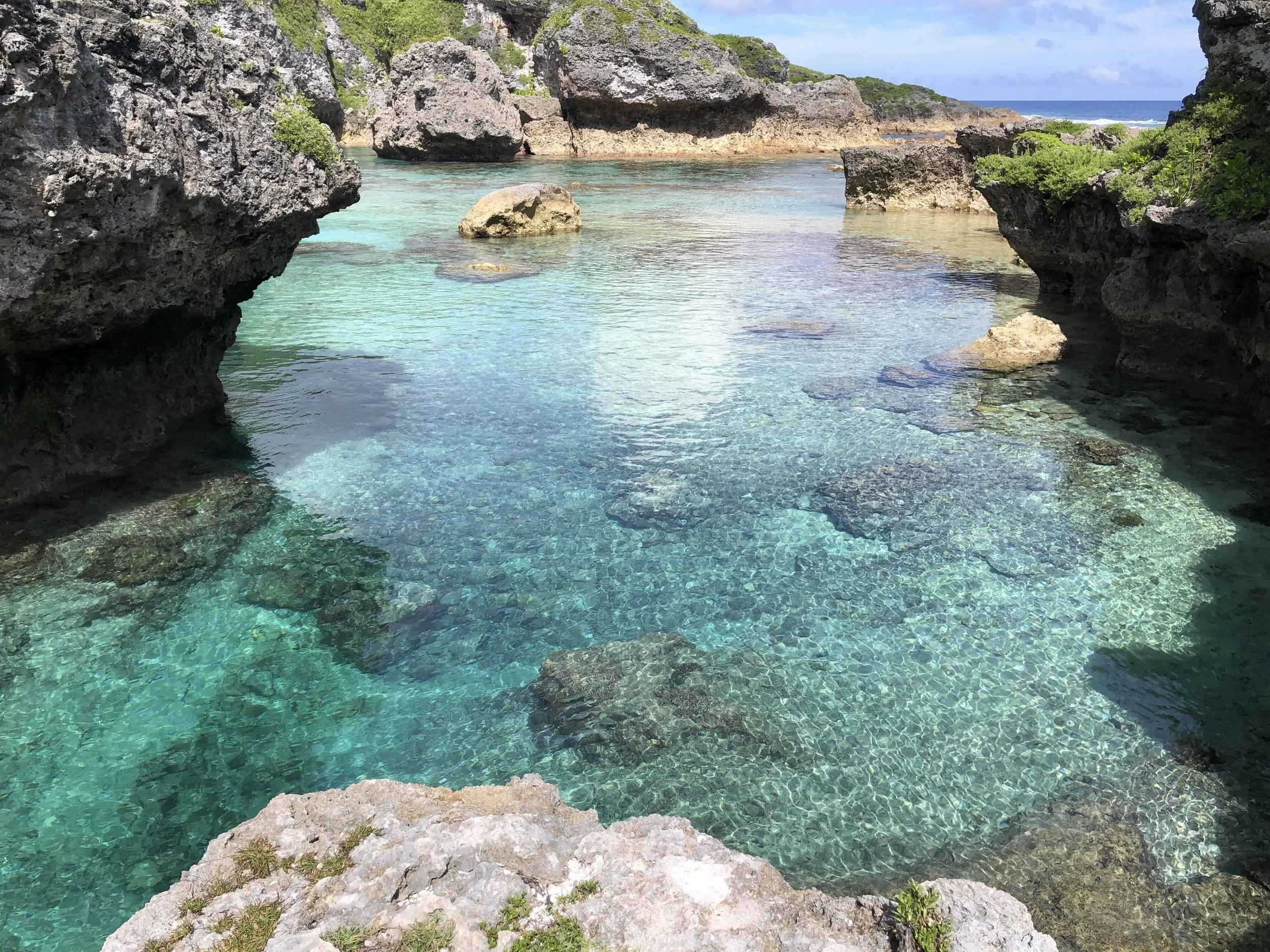
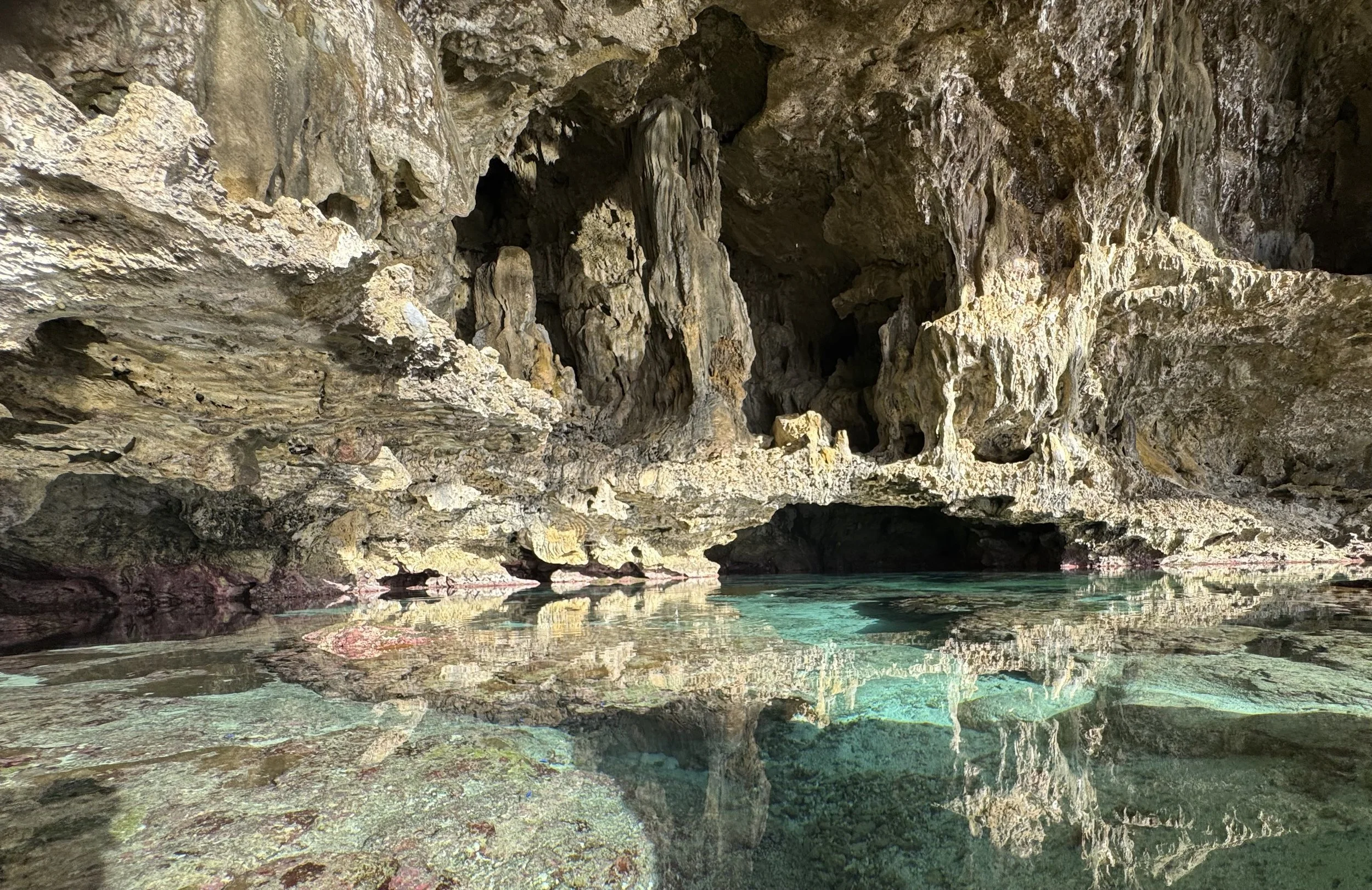
Being on the island for 11 days allowed for plenty of time to explore and enjoy the wonderful sites and experiences this special island has to offer. There are several sites along the western coast where you can easily access spots for snorkelling or swimming. Limu Pools and Matapa Chasm were close to where we were staying and were popular. Avatele Bay was also a great spot where the more adventurous swam out the channel to explore the ocean on the outside of the reef. Both Togo and Anapala Chasm were also special places to visit. The landscape of weather worn sharp limestone coral along the tracks leaves you in awe of anything being able to grow. The walk into Togo Chasm is a great area for spotting the famous uga/coconut land crabs, which are a prized food for the locals. Anapala Chasm is unique in that it is full of fresh water and a wonderful spot for a dip. A short walk from the start of the Anapala Chasm track leads you down to the wild southern coast of the island. Here you can sit for long periods of time just watching the glorious turquoise waves roll into the shore – quite mesmerizing.
On the Wednesday night before we departed the Department of Environment put on a buffet dinner for us all at the family owned Manuiz café. This was a wonderful wrap up and celebration of our shared work with Huggard and his team. His comment that “there was always roars of laughter in the forest when we were working” summed up the spirit of the group.
Conclusion
While removal and treatment of African Tulip Tree at the three major infestations sites was achieved, ongoing surveillance and follow up work will be required before Niue can declare that this particular invasive is eradicated. Crucial to the surveillance will be some high-quality aerial imagery of the tree canopy across the island at a time when African Tulip Tree is flowering and easy to identify. A single missed tree will over time initiate a new infestation site.
For me this was one of the most rewarding volunteer activities I have been involved in. Work is already underway for ‘Friends of Niue’ year 2 with flights and accommodation on the island booked for August of 2026. There will be follow up work on African Tulip tree and plans to remove a single infestation of wood rose opposite the quarry(13), and possibly some Taro vine. I am hoping that ‘Friends of Niue’ will be a long running annual volunteer effort as is the case with the ‘Friends of Lord Howe Island’ which has now been running for close to 25 years.
We Were
Barry Scott, Christine Scott, Frances McClure, Kim Bannister, Prue Smith, Andy Thomson, Harley Betts, Katherine Gibbs, Andrea Sim, Stu Hanchet, Neroli Amyes and Kevin Bolitho.
Huggard Tongatule, Biodiversity and Conservation Officer, Department of Environment.
Acknowledgements
Many thanks to Huggard Tongatule for enthusiastically embracing our request to do plant invasive volunteer work on Niue, for organizing all the logistics around the work for us and his team, and making all the necessary arrangements with the Niuean Government. Also, Shiloh Pasisi, who helped with a lot of the paperwork for ‘Mission Clearance’ and shipment of tools.
References
-
African tulip tree https://inaturalist.nz/observations/313484881
-
Pete McKenzie and Richard Robinson (2024). The Fight for Niue. New Zealand Geographic Issue 189 https://www.nzgeo.com/stories/the-fight-for-niue/
-
Friends of Lord Howe Island https://friendslhi.com.au
-
Quentin Paynter and Lynley Hayes (Bioeconomy Science Institute. Manaaki Whenua – Landcare Research Group). African Tulip Tree https://www.landcareresearch.co.nz/discover-our-research/managing-invasive-species/weed-biocontrol-in-the-pacific-region/target-weeds-and-nens/afric
-
Indigo Michael (Bioeconomy Science Institute. Manaaki Whenua – Landcare Research Group). Progress for taro vine in the Pacific https://www.landcareresearch.co.nz/publications/weed-biocontrol/weed-biocontrol-articles/progress-for-taro-vine-in-the-pacific
-
WR (Bill) Sykes. Contributions to the flora of Niue. New Zealand DSIR Bulletin 200. Government Printer, Wellington.
-
New Zealand Plant Conservation Network. Remembering Art Whistler 1944-2020, American botanist. https://bts.nzpcn.org.nz/site/assets/files/0/24/562/ak_bot_soc_journal_75_1_jun_2020_135-136.pdf
-
Rhys Gardner (2021). Auckland Botanical Society Journal 76 (1).
-
Kim Bannister YouTube video: https://youtu.be/9eLffrQqAI4
-
Lou Sanson. The Press. Sept 6, 2025. Tiny Niue leads the world with big conservation ambitions https://www.thepress.co.nz/nz-news/360791652/tiny-niue-leads-world-big-conservation-ambitions
-
Bezos Earth Fund. $4 million grant to Niue Ocean Wide Trust. Securing Permanent protection and sustainable management of Nuie’s moana mahu marine protected area.
-
Wood rose vine https://inaturalist.nz/observations/314261968