
Effects of Cyclone Gabrielle on Aotea’s Beach Birds
JOHN OGDEN
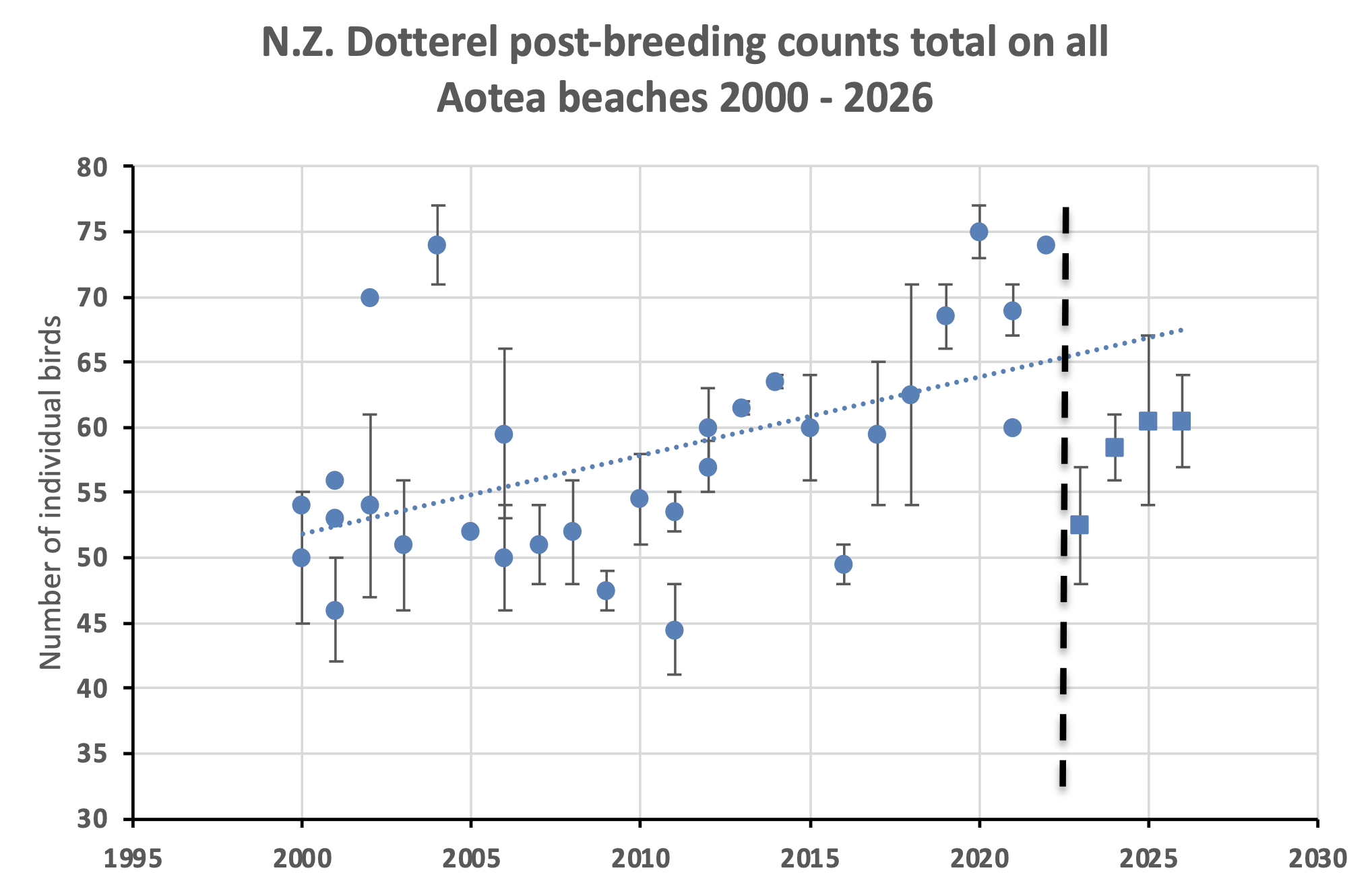
Figure 1: New Zealand dotterel counts, summed for all occupied beaches on one day, usually in March. Years with more than one ‘dot’ were counted twice in that year. Error bars are ‘counted maxima’ and ‘minima’ rather than standard errors. The trend- line (dotted) is based on pre-Gabrielle counts. The vertical dashed line indicates the timing of Cyclone Gabrielle just prior to the 2023 count. Counts since then have square symbols.
Cyclones, hurricanes, typhoons: however we name those enormous low-pressure systems that develop in the tropics and spin out into sub-tropical and temperate regions, they not only damage human infrastructure and take lives, they are also often responsible for resetting natural ecosystems. Throughout New Zealand, regional forest patterns and local structure reflect the effects of past storms and other infrequent catastrophic events . Old forest can be flattened, coastal dunes moved great distances inland, estuaries and coastal lowlands flooded and re-shaped. The likelihood of such events is growing with the warming of the oceans.
I, and others in ecology groups, have been counting New Zealand Dotterels on ‘all’ the Aotea beaches since 2000. The overall aim each year has been to get a count for the whole Island, so all Aotea’s main beaches needed to be counted on the same day. Banding and careful observation showed that many dotterels move from their breeding beaches to Whangapoua Estuary after breeding. Those birds accumulate as a loose flock on Okiwi Spit when the estuary is flooded at high tide. It became obvious that the ‘flock’ on the Spit represented a large proportion of the Island’s New Zealand dotterels, and was the most important place to get an accurate count from. Also, enough New Zealand dotterels have been banded on Aotea to prove that New Zealand dotterels can live a long time and sometimes move between the island and Coromandel. For example, “metal/ yellow” (M/Y, leg bands) appeared on Okiwi Spit two years after Gabrielle and 18.2 years after being banded, as a chick, on Matarangi Beach, Coromandel!
Although NZ dotterels are easily identified, when they are in post-breeding (pale) plumage and mixed with the confusingly named banded dotterels (also in winter plumage), and all are moving about, counting becomes more an art than a science! Generally, two or more people do this independently and agree on the total. The double counting is always done more than once. The count recorded is usually the average of the agreed minimum and maximum.
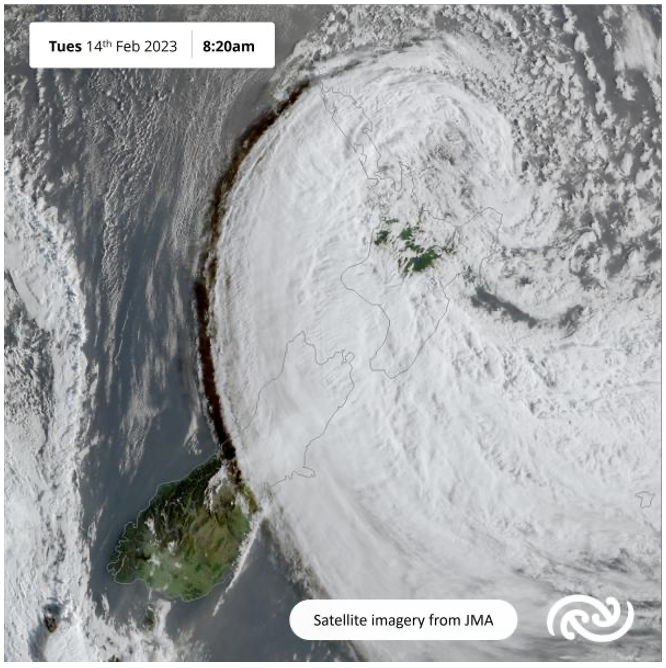
Figure 2: Cyclone Gabrielle, showing the ‘eye’ SE of Coromandel
The average count over 26 years is 58 with a minimum of 55 and maximum of 61 (rounded figures). However, considerable variation surrounds the long-term increasing trend (dotted line in Fig 1.). There are some exceptional values (2004, 2020) and periods of apparent decline (2014-16). This variability is a common feature of long-term bird-monitoring data, probably mainly reflecting differences in counting circumstances (e.g. weather) on the day, accidental re-counting of individuals or, in this case, possible inclusion of banded dotterels.
The next obvious thing on the figure is the vertical line indicating the occurrence of Cyclone Gabrielle on 14th February 2023 (Fig 2). The dotterel counts were made (as planned) ten days later on February 24th. The spit, reshaped by the cyclone, had only 40% of the birds recorded in the previous year. Since then dotterel numbers have crept up again, apparently following the pre-Gabrielle trend, but numbers are currently only back to the 2015 level.
Variable oystercatchers also gather on Okiwi Spit after breeding. Without simultaneous counts on many other beaches and rocky bays on both coasts it is uncertain what proportion of the total Aotea population this Okiwi gathering represents. However, since 1999 ‘the flock’ has been counted and scattered individuals and pairs present along the beach (presumed ‘residents’) added as ‘the total’. Some years the flock count was not recorded separately, so only a total was recorded. I believe the flock mainly represents juveniles, but it could be birds visiting Aotea from elsewhere. As Fig 3. demonstrates, both the flock and the total counts have been increasing rapidly since 2000 and both exhibited a dramatic decline after Cyclone Gabrielle.
The count for 2025 should be noted; on March 23rd there was definitely no flock present on the spit, though a week later Sue Moore counted a flock of over 40, and a total of over 70. I already knew that the flock sometimes moved elsewhere, usually to wet paddocks or the Okiwi airstrip, to feed on rising worms, so presumably this was such a case. However, disregarding the 2025 zero, the flock was reduced by at least 20% compared to the pre-Gabrielle decade.
As the cyclone hammered both coasts of Aotea for three days, it seems likely these proportionate losses are representative for both species and possibly others. Recovery would require average or above-average breeding success for several years, or immigration of birds from elsewhere. Given that the destruction from the cyclone was equally bad on the coromandel coast, immigration seems unlikely, but not impossible. Dotterel breeding success (birds fledged/pair/year) at Medlands beach has averaged 0.5 since 2023/24, unchanged since before that time. Given an average adult life expectancy of >4 years, the population is expected to continue to slowly increase. The dotterel population is not ‘bouncing back’, but it is slowly building at the same rate as before.
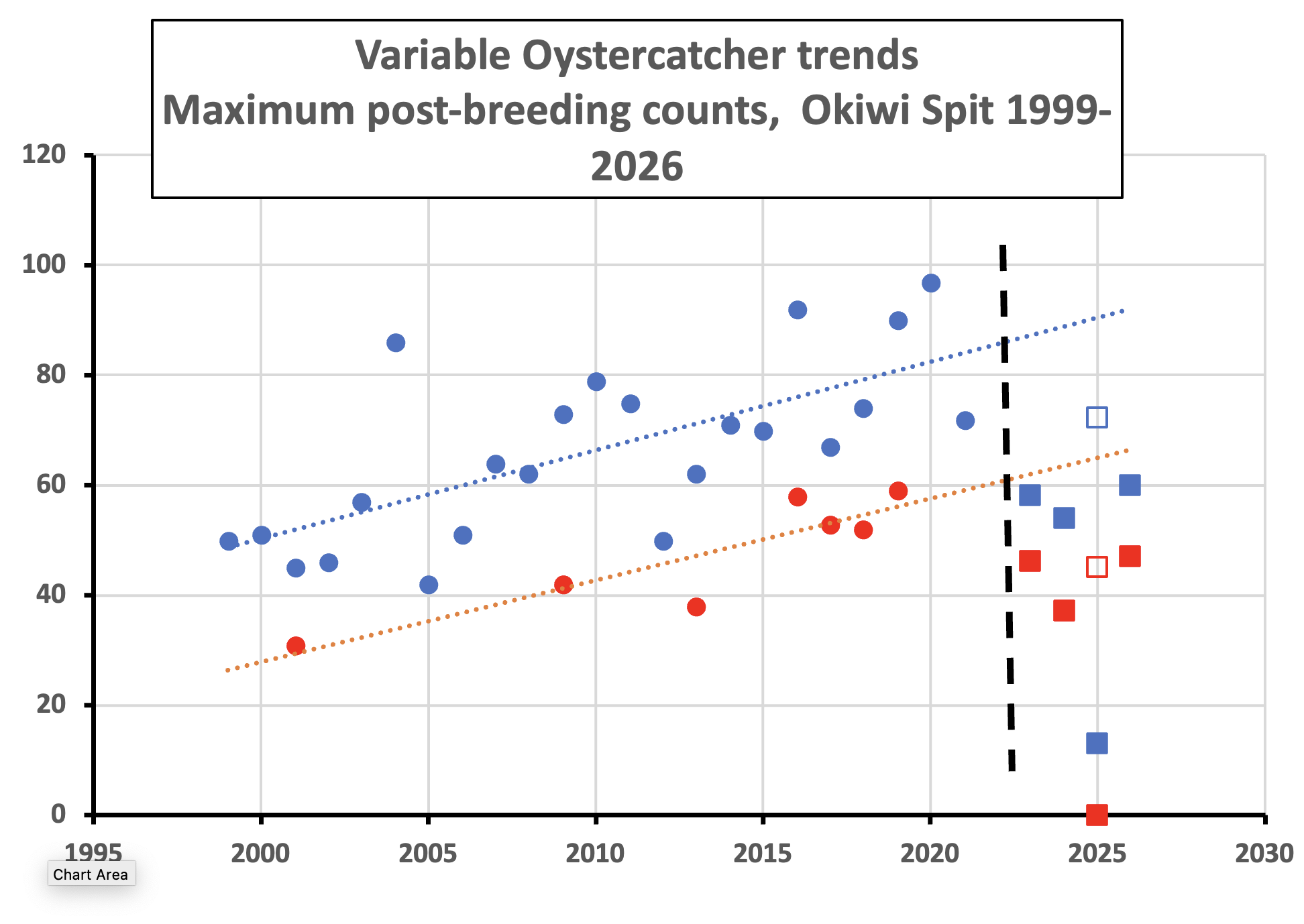
Figure 3: Variable oystercatcher trends on Okiwi Spit over 27 years. Red points are discrete flock counts, blue are flock plus others. Flock not recorded separately in all years. Square points after Cyclone Gabrielle (vertical dashed line). Unfilled square points from Sue Moore (Ebird) 30/3/2025.
In contrast to dotterels, since the cyclone oystercatcher breeding success on Medlands beach has declined; in the 2024/25 season it was zero fledged young from 6 adult pairs. A similar situation was reported elsewhere. As oystercatchers do not usually breed until their third year, mortality of sub-adults, ready to form pairs and gain territories, is likely to be much worse for a population than failures of eggs or small chicks, though these are more numerous and obvious . Thus, the long pre-reproductive period of oystercatchers (3 years) renders them more vulnerable than dotterels, especially to closely sequential mortality events. However, despite this, variable oystercatchers are numerous and increasing on Aotea, so there is no immediate concern for their continued noisy presence on our beaches. New Zealand dotterels are also recovering well, but that success is largely due to human care of nesting birds on our beaches, and on Coromandel.
References
Ogden. J., Lusk, Ch. H. Steel M. G. 1993. Episodic mortality, forest decline and diversity in a dynamic landscape: Tongariro National Park, New Zealand. In: Huettl & Muelle Dombois (eds). Forest Decline in the Atlantic and Pacific Regions. Springer -Verlag, Berlin Heidelberg. (There are numerous reviews of papers on wind-throw in NZ and elsewhere).
Ogden, J. (1993). On Cyclones, Pisonia grandis and the mortality of black noddy (Anous minutus) on Heron Island. Emu 93: 281-283. (Massive mortality of eggs and chicks had almost no discernible impact on adult population growth in following years).