
A Feral Cat Free Aotea
Barry Scott talks to CHRIS GIBLIN (Feral Cat Operations Manager for Tū Mai Taonga) and MAKERE JENNER (Project Lead for Tū Mai Taonga) about feral cat removal on Aotea
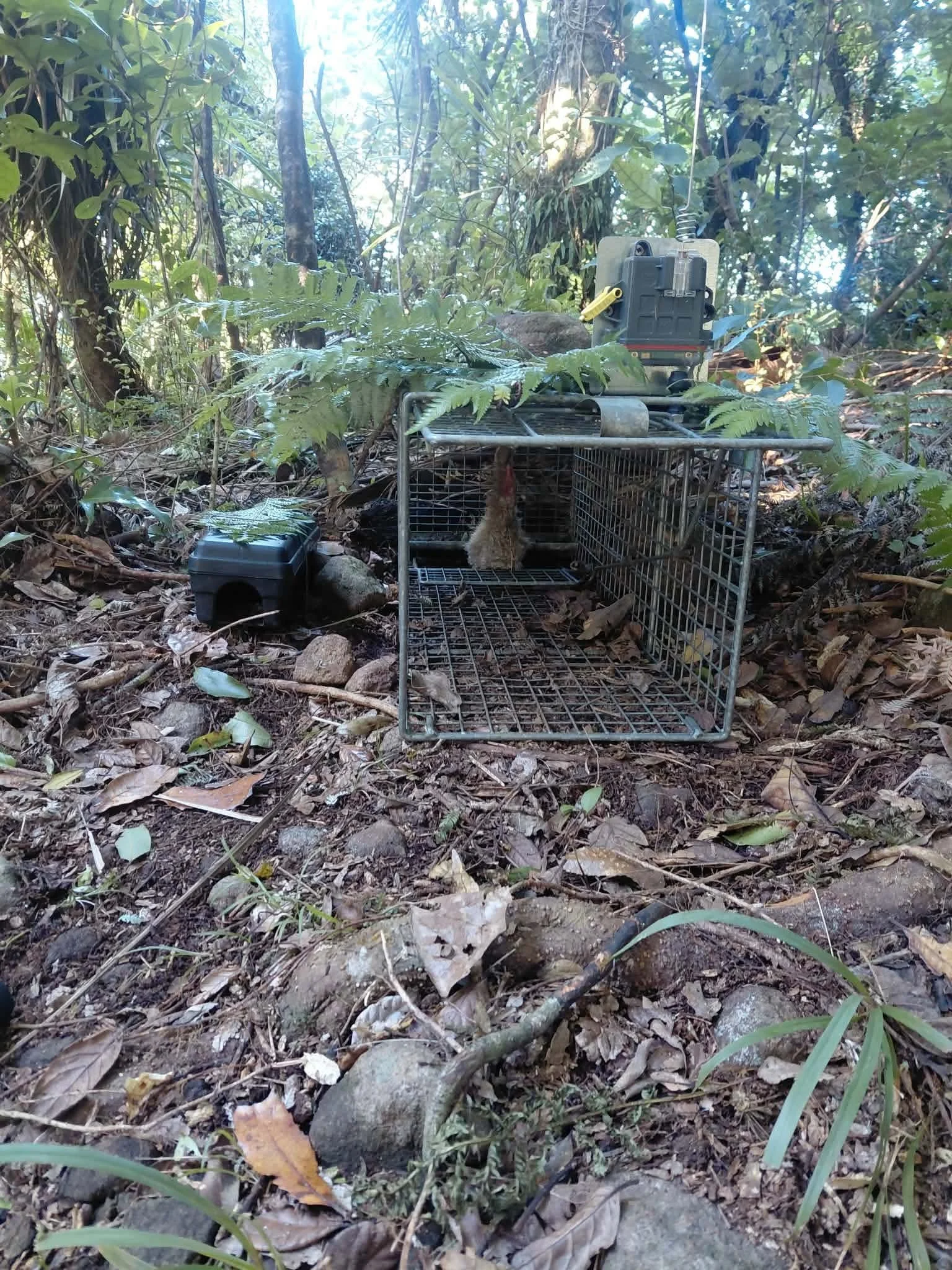
Cage trap with rabbit bait and remote sensor (Credit: Tū Mai Taonga)
It is now four years since Tū Mai Taonga, a Ngāti Rehua-Ngātiwai ki Aotea-led conservation project on Aotea/Great Barrier Island, was set up to remove feral cats and rodents from Aotea. The feral cat eradication component of this project is one of the world’s most ambitious given the size (285 km2) and rugged topography of Aotea and the fact it is inhabited. I spoke to Chris Giblin, Feral Cat Specialist, and Makere Jenner, project lead for Tū Mai Taonga, on progress to date and the challenges they have faced so far in achieving their goal of feral cat eradication on Aotea.
The Operation
The approach adopted by Tū Mai Taonga was based on a feasibility study(1) that recommended to first remove feral cats from Te Paparahi and use the knowledge and capability gained there to progressively work down the island in stages, through five different zones, working with landowners, Auckland Council, DOC and community groups, and within a framework that would protect domestic cats.
As Makere says “cats are New Zealander’s favourite companion animal” so it is imperative to have a programme that ensures domestic cats are protected. Here they drew on the experience of Auckland Council who had been operating in the Auckland region for a number of years. Huge efforts were put in by Auckland Council to build trust with the community through making it very clear (i) what methods they were going to use to trap feral cats and (ii) what their expectations were of domestic cat owners to ensure their cats could be distinguished from feral cats. All trapping by Auckland Council is live capture using large open cages. If domestic cats have a collar and/or a clipped ear they are released, otherwise they could be assumed to be feral. Microchips help reunite domestic cats with their owners, but chipping alone is insufficient to correctly classify a domestic cat as a pet, as chips sometimes move within the animal and can be missed by a chip reader. On Aotea there is now the added protection of an online domestic ‘Cat-alogue’, containing photos of all registered domestic cats on the island. All Tū Mai Taonga trappers can access the ‘Cat-alogue’ on their phones. When they come within two km of a catalogued domestic cat it shows up on their phones. DOC, Auckland Council, Windy Hill, Oruawharo Medlands Ecovision, Glenfern Sanctuary, Ecology Vision and Tū Mai Taonga joined the ‘Safe Cat’ programme in support of this approach. However, the ‘Cat-alogue’ is an adjunct to, rather than a replacement for, the need for a collar or a clipped ear as the match between a cat in a trap and an image in the ‘Catalogue’ may not always be clear, for example if the cat in the trap is wet.
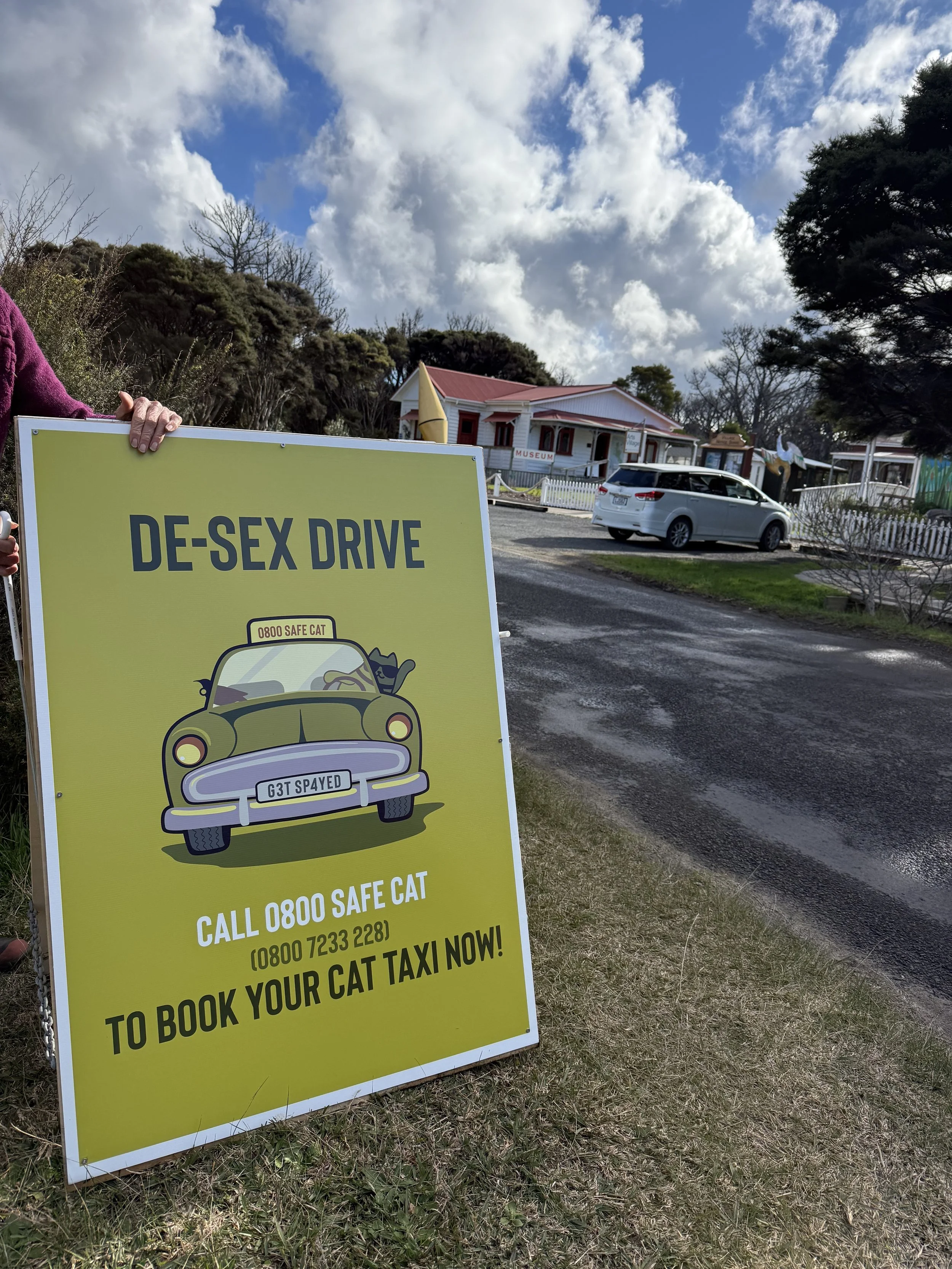
De-Sex Drive Signage at Claris (Credit: Tū Mai Taonga)
The recently established ‘Safe Cat’ programme, which is a collaborative effort between all key organisations on the island involved in feral cat trapping, outlines a series of procedures and practices that will be used to recognize and protect domestic cats. Equally, it lays out what domestic cat owners can do to keep their companion cat safe: ensure their cats are entered on the ‘Cat-alogue’, have some external form of recognition in the field, and are preferably chipped and desexed. Unless these steps are taken by everyone the effort to remove feral cats from the island could be undone. While chipping and desexing is not compulsory it may be considered in the forthcoming revision of the Regional Pest Management Plan (RPMP).
Given Te Paparahi was mostly untracked, with the exception of the single walking track through the centre from the Whangapoua Road to Mt Tataweka, the first thing that had to be done before trapping could commence was to upgrade this track to allow light utility vehicle (LUV) access to serve as a feed to a network of tracks that were cut from this central access. As Chris says “tracks need to be at least half a metre wide so it is easy for workers to carry a cage unimpeded along the track.” Over a period of about one year a 90 km track network was laid out across Te Paparahi. Traps were then carried in by LUV or ferried by sea to key drop off points before being laid out at a density of at least one every 20 ha along ridgelines, which coincides with known cat movement and is the recommended density for feral cat control. Lugging in all 230 traps was hard physical work that needed fit and strong workers.
Despite the absence of domestic cats in this huge area Chris said they opted for cage traps rather than kill traps as their preferred method to capture and remove feral cats because these are very wary animals that dislike putting their head into a small confined space. In contrast an open cage is less ‘frightening’ for them so they will more readily enter these. This was something he learnt from over 20 years of trapping feral cats around the country, including in Okiwi, where they were hauling out around 120 feral cats each year. Also, feral cats learn and adapt to one particular trapping method so it is important to maintain other methods in the tool box for later use. While cages are the method of choice for intensive ‘knock down’ of the population in a new block, other tools such as the Steve Allan (SA2) kill trap and leg traps are deployed to ‘mop up’ the remaining feral cats. All trapping methods used by Tū Mai Taonga meet the National Animal Welfare Advisory Committee (NAWAC) guidelines for animal welfare. Another key animal welfare requirement is feral cats have to be euthanised or released from cages within 12 hours of sunrise. To ensure this happens all cages are fitted with a sensor that is activated when the trap springs, resulting in transmission of a radio signal back to base and mobilisation of a worker to the field site. Each trap is linked to a very sophisticated Geographic Information System (GIS) is used to capture, store, manage, analyse and visualise spatial and geographic data. Although the initial GIS system was set up by Ethos Environmental(2) it has since been modified in-house to tailor it to the specific needs of the Tū Mai Taonga project. This system can be readily replicated at any other site.
Since the beginning of 2025 around 400 animals have been removed from the Te Paparahi (zone 1) and Okiwi (zone 2) blocks. While the average weight of these animals was in the range of 3-4 kg some feral cats were as heavy as 5.6 kg – very large cats!, However, Chris recounts how some of the feral cats they caught on the Chathams weighed up to 11 kg – absolute whoppers! If there is the same density of animals throughout Aotea as found in zones one and two we can estimate, based on the area of these blocks, that the total feral cat population on Aotea is around 2500. Based on trail camera information, Chris estimates there are less than 15 animals remaining in the Te Paparahi block. Given feral cats can move from one side of the island to the other within 24 hours it is crucial to know where they are located so that targeted approaches can be deployed to capture them. This is where the trail camera network is crucial in identifying exactly where they are. Capturing those few remaining animals is very challenging as they are probably among the most cunning in the population. This is where everything is thrown at them including the use of kill traps (deployed far from domestic cats) and leg holds. Like the cage traps the latter are also linked to sensors to ensure a trapper is mobilized within 24 hours of a ‘trip’ signal being received at the Akapoua headquarters. The other main challenge facing the team is an apparent change in the breeding behaviour of the remaining feral cats. In March of this year a female feral cat was caught in Okiwi with a litter of seven kittens, when usually feral cats have litters of around two-to-three on average. Six of those kittens were female! The remnant population of feral cats also appear to be having litters more frequently, highlighting the need to move from low numbers to local elimination as quickly as possible.
Data collection is an important component of their trapping programme. The performance of different trapping methods is monitored by comparing catch rates per 100 trap nights. When feral cats are caught they are dissected in the field to record the contents of their stomach. This can include a mix of bird feathers, and remains of rabbit, rat, insect and lizard tissue. When females are caught information on whether they are pregnant or not is also recorded. All data is entered directly onto the phones of the trappers and uploaded to a central repository when they return to base.
While the trail camera network provides key information on the identification and movement of feral cats it also provides a wealth of information on what else is active in the forest. Two surprising but very interesting observations have been how widespread both pāteke and rabbits are within this area of forest. Groups of pāteke have been sighted throughout the forest and at remote beaches around the coast of Te Paparahi. While we generally associate rabbits with open, low density vegetation areas such as dunes, they are in fact found throughout Te Paparahi highlighting how difficult it will be to ever eradicate them from Aotea.
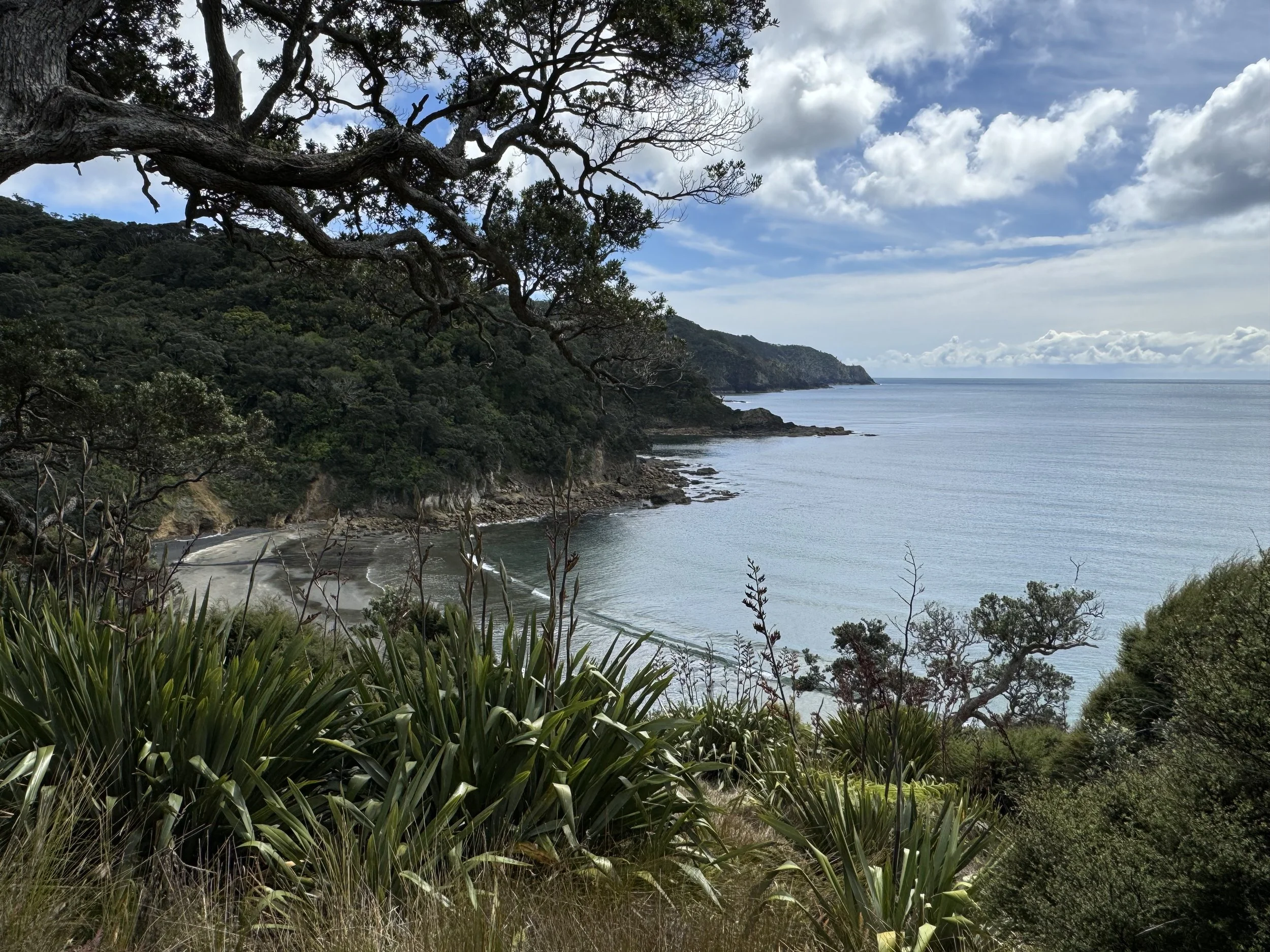
Rangiwhakaea Bay (Credit: Barry Scott)
Crucial to catching feral cats is the choice of lure. “By far the best lure for catching feral cats is rabbit”, says Chris. “But with over 300 cages in use at one time it became difficult to find enough rabbit on the island to service all these traps. So frozen chicken was deployed and that has proven to be a very effective bait.” Fresh baits like rabbit and chicken last just 2 days in summer but up to 5 days in winter, which considerably narrows the window of time when a feral cat can be caught. But what might be a gamechanger is a new plantbased lure called silvervine that is very attractive to cats(3), a bit like catnip, only much more attractive. This lure is derived from a relative of the kiwifruit, called Actinidia polygama, a species that is used as a rootstock for grafting commercial kiwifruit varieties. The use of such an unlikely lure arose from the observation by a kiwifruit grower that feral cats frequented the rootstock area of his orchard where they were sighted rubbing their bodies up against the vines. Plant and Food, now part of the newly established Bioeconomy Science Institute, received funding to investigate this interesting observation further. Working in partnership with Ngāti Rehua-Ngātiwai ki Aotea Trust through its Tū Mai Taonga project on Aotea and Te Rūnanga o Ngāti Mutunga in Taranaki, they are trialling the effectiveness of different preparations of silvervine as a lure to catch feral cats. The first trials on Aotea were carried out in February of this year where duplicate bait feeders were set up offering a choice of rabbit meat from one and silvervine product from the other. While there was interaction with both lures the average interaction rate with the silver vine was greater than with the rabbit. These results are encouraging and more research is being done using this product commercially as a lure for attracting feral cats to traps. Given this product can be packaged and stored in a way that prevents deterioration in the field it has the potential to be active in the field for long periods of time thereby reducing the servicing time of traps in the field considerably as well as enhancing the strength of the feral cat interaction with the lure, and an increased probability of being caught. One major issue with this lure is getting enough of the plant material, so Tū Mai Taonga project is looking into growing this vine on Aotea.
Placement of traps is also important. As Chris says “feral cats are like water and will take the path of least resistance – along roads, fencelines and tracks.” As the team clear tracks to lay the traps on Aotea they are also creating new paths that feral cats will use. On average a trap is placed along tracks about every 300 metres to maximise the opportunity for a feral cat to encounter and interact with a trap, which is crucial to them being caught.
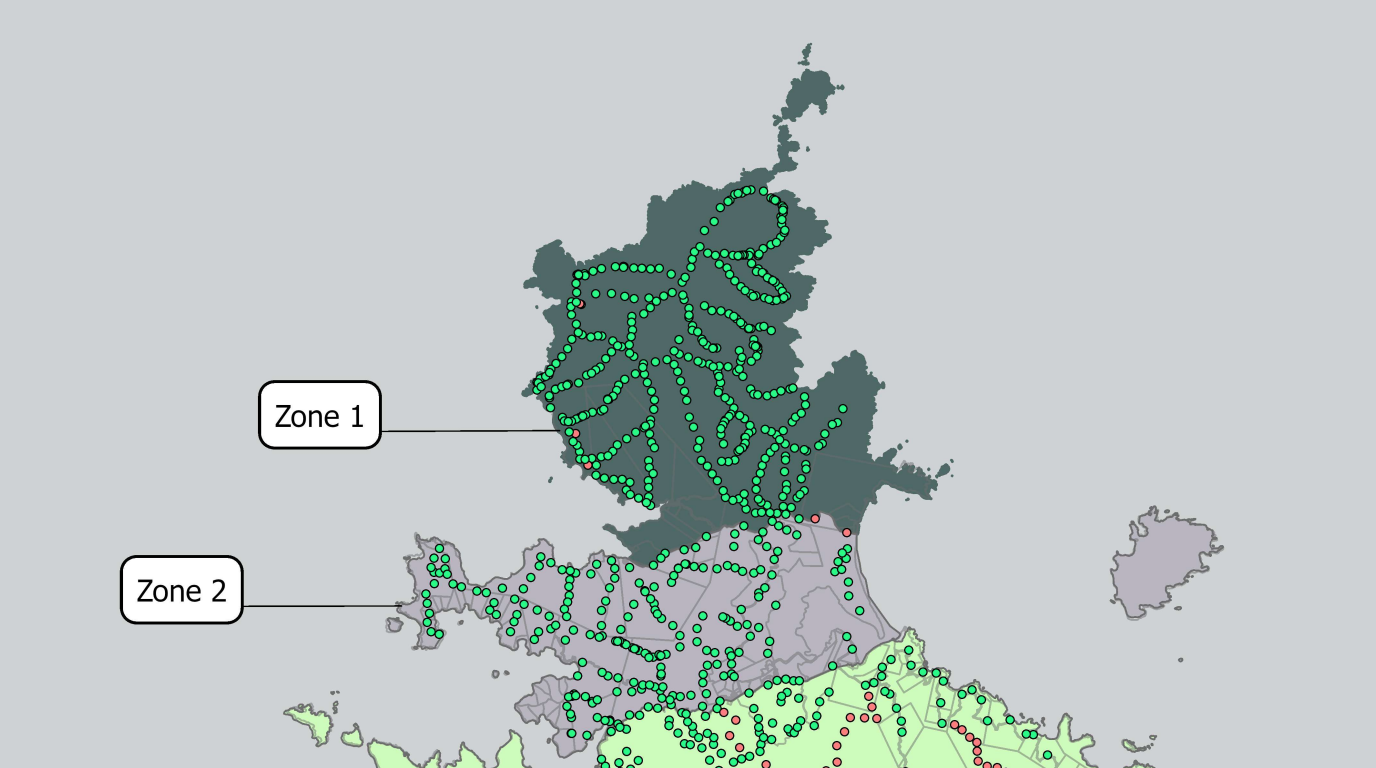
Trap lines through zones 1 and 2. Green circles are current trap lines and red circles are proposed (Credit: Tū Mai Taonga)
In January 2026 the operation moved from zones one (Te Paparahi) and two (Okiwi) into the central zone three that extends from Okiwi through to the Kaitoke river; a geographically complex and challenging area of terrain. As with the operations in the north engagement with the community was first undertaken to identify private land owners who were comfortable with having traps on their property and those that were not. Where permissions were not obtained a work around of using traps on neighbouring properties still allows for feral cats to be captured due to the long distances these animals move. When numbers become low the home range of a feral cat can increase from around 20 ha to 400-500 ha. As with zones one and two the first phase involves an intensive ‘knock-down’ phase followed by more concentrated efforts to ‘mop-up’ remaining feral cats identified from the trail camera network. As of June this year they are still in the knock-down phase with a lot of infilling still to do to completely cover the very complex and challenging terrain of this zone. Given how few feral cats now remain in zone one (Te Paparahi) some of the traps from this area may be moved into zone three. However, with this expanded area the trap network across Aotea now comprises around 1000 cage traps.
As the Ngāti Rehua-Ngātiwai ki Aotea Trust’s Tū Mai Taonga project moves south they will be in areas that are more populated so the first major task ahead of them is to engage with the local community to explain to them what they plan to do, the methods they will deploy to capture the feral cats, and how domestic cat owners can help. Here the ‘Safe Cat’ programme will become more important as there are more domestic cats within the communities of Claris, Whangaparapara, Okupe, Medlands and Tryphena. As Makere says “this is where starting in the north has been very helpful as many people on the island are now aware of the Tū Mai Taonga project, how it is operating, and its success to date.” They are hoping that by working closely with domestic cat owners, the community will be on board with the goal of a feral cat free Aotea. In July this year there will be a big ‘Safe Cat’ launch with a drive for domestic cat owners across the island to have their pets desexed and chipped. As Makere says “showing people we are here to support them and keep their pet cat safe is key.”
Conclusions
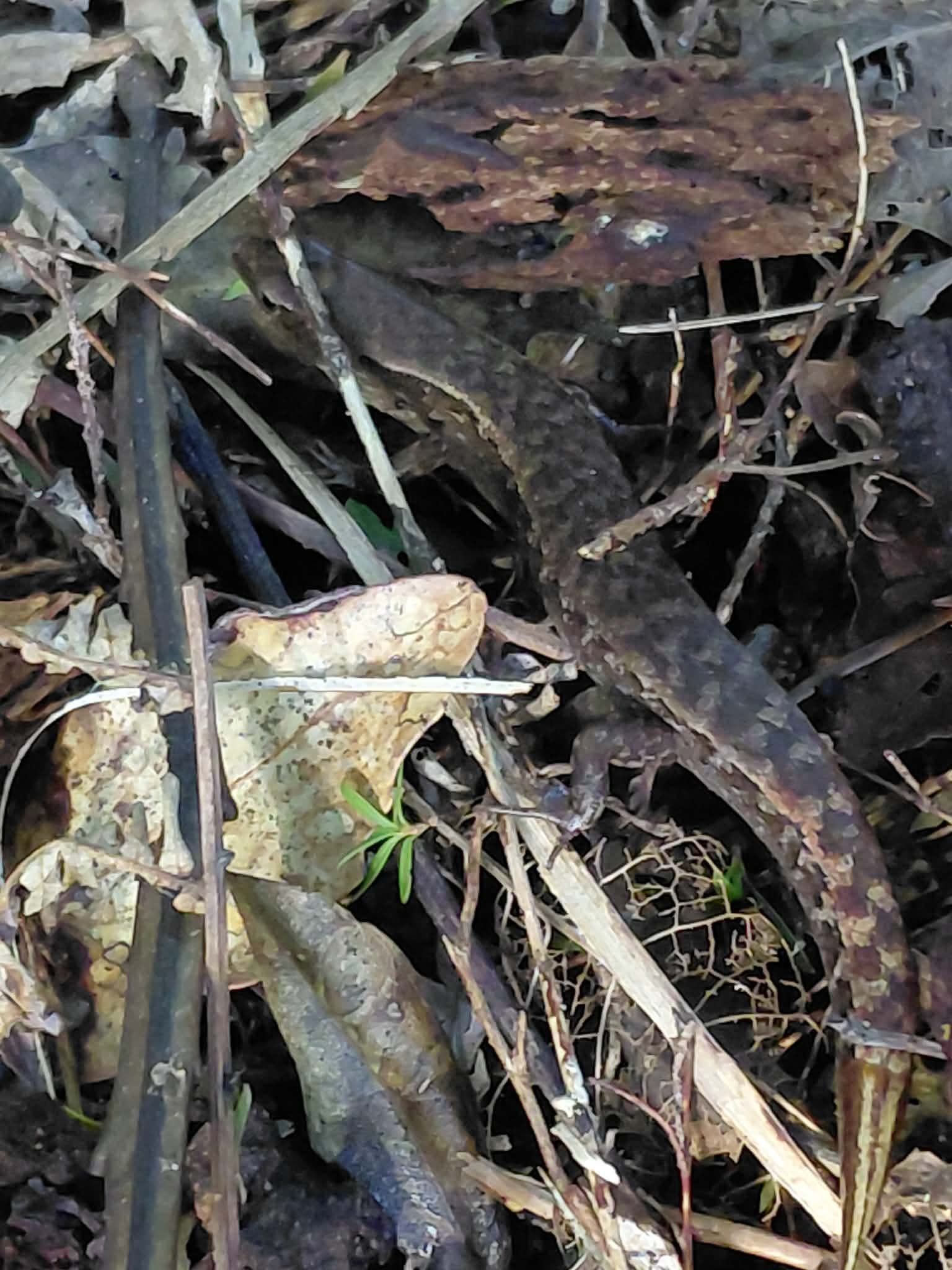
Niho taniwha/Chevron skink in Te Paparahi (Credit: Tū Mai Taonga)
After a relatively slow start, the feral cat eradication project on Aotea is now well advanced. Some of the benefits are already being realised with greater bird song throughout Te Paparahi than when the project started back in 2022. As Chris says “the operation is now a lot more sophisticated. The technology has evolved considerably; the newest cameras are AI enabled and operate across a 4G network. We have a very sophisticated in-house GIS system set up to monitor, analyse and record all data generated from the trap and trail camera network, and a highly skilled and well-trained team to carry out the day-to-day operations. Response times are faster. The technology enables us to find and target the remaining feral cats after the initial knock-down phase. In the early stages of the project we relied considerably on the knowledge and experience of similar operations in Australia, such as the one on Kangaroo Island. Now we are operating at a similar level of sophistication and in a position to now offer them some advice. We are probably one of the largest and most well set up feral cat control programs in the Southern hemisphere. Jobs for Nature through DOC and Predator Free 2050 Limited launched the project in 2021. Continued funding from DOC and Auckland Council has been joined by new funding from Foundation North and others to ensure the project can continue towards making Aotea feral cat-free.
From my discussions with Chris and Makere I feel very confident that feral cats will be removed from Aotea in the very near future. Then there will be the challenge of removing rats from the island, but that is a story for another day.
Acknowledgements
Ngāti Rehua-Ngātiwai ki Aotea Trust acknowledges support for this project from DOC, Predator Free 2050 Ltd, Auckland Council & Foundation North.
References
John Parkes (2022). The Tu Mai Taonga project; Towards removing feral cats and rodents from Aotea, Great Barrier Island. Kurahaupo Consulting Contract Report: 2022/24 for Ngāti Rehua-Ngātiwai ki Aotea Trust.
Tay NE, Du B, Gillam TA, Thomas ML, Algar D and Flemming PA (2026). Feral cat responses to silver vine: implications for feral cat management. Journal of Chemical Ecology 52(2): 34. doi: 10.1007/s10886-026-01707-5